Maharashtra State Board has included ‘expansion of idea’ as a writing skills in the syllabus of Std 11 and 12. Here you will find necessary steps to follow with example of expansion of Beauty Is Truth Truth Is Beauty. Given steps will be applicable for other ideas. You should practice expanding proverbs in English. Be confident and come out of English phobia.
The History of the idea.
What does the idea mean?
How has the meaning of the idea changed over time?
Examples to prove the idea
Why is the idea still relevant today?
Conclusion
Expand an idea inherent in the phrase Beauty Is Truth Truth Is Beauty
When it comes to art, there is often a debate about the relationship between truth and beauty. Some people believe that truth is beauty , while others believe that beauty is all that matters. There is no right or wrong answer to this debate, as it is completely subjective. However, it is interesting to explore the different ways that artists have interpreted this relationship. The phrase “beauty is truth, truth is beauty” has been quoted by the poet John Keats in his poem’ Ode To Grecian Urn’ . He was commenting on the relationship between art and reality, and how beauty can be found in even the most mundane aspects of life.
Keats believed that beauty and truth were two sides of the same coin. He felt that the truth could be found in beauty, and that beauty was a reflection of the truth. The phrase “beauty is truth, truth is beauty” has been used in art and literature for centuries Initially, the phrase was used to emphasize the power of beauty and the importance of truth. Beauty was seen as a way to reveal the truth behind the world, and truth was seen as the most beautiful thing in the world.
However, over time the phrase has taken on a different meaning. Now, it is often used to describe the relationship between art and reality. Art is seen as a way to reflect the truths of the world, and beauty is seen as a way to make those truths more accessible to people. Think about some of your favorite pieces of art. Are they beautiful, but devoid of truth? Or are they based on real-world events or people, but not particularly pretty to look at?
In most cases, the best art is both beautiful and true. It embodies the phrase “beauty is truth truth is beauty.” The artist has taken the time to find the beauty in the world around them and share it with others.
You might be wondering why this phrase is still relevant today. After all, it was written over 200 years ago by a British poet named John Keats. There are several reasons why this phrase is still relevant today. For one, it captures the relationship between truth and beauty. Beauty is often seen as an ideal, and truth is often seen as the factual reality. However, the two are not always separate. In many cases, the truth can be beautiful, and the beauty can be true. This phrase also speaks to the power of art. Art can be a way of exploring the truth and capturing beauty in a way that is meaningful and powerful.
Art is about interpretation and perception. Beauty is truth, and truth is beauty. Art is about finding the balance between the two.
Frame wh questions is a popular term in English Grammar. It is asked in almost all exams of any class, even in competitive exams. Mostly the statement is given with underlined part. Instruction is given to frame wh questions to get the underlined part as an answer. Become master in English by learning wh questions. One should understand the basics of Wh words like what, who, when, where, how, which and why.
How to select wh word to frame questions.
Frame question with ‘What‘ if underlined part is thing / object .
Example: He needs breads. Ans. What does he need?
Frame question with ‘Who‘ if underlined part is person/subject.
Example: Arvind Kejriwal is the Chief Minister. Ans. Who is the Chief Minister?
Frame question with ‘Whom‘ if underlined part is person but in place of object of verb.
Example: Teacher gave warning to Amit. Ans. Whom did teacher give warning?
Frame question with ‘When‘ if underlined part indicates time.
Example: India got freedom in 1947. Ans. When did India get freedom?
Frame question with ‘Where‘ if underlined part indicates place.
Example: Students went to the Red Fort. Ans: Where did students go?
Frame question with ‘Why‘ if underlined part indicates reason.
Example: They are late because they missed the bus. Ans. Why are they late?
Frame question with ‘How‘ if underlined part is adjective/adverb.
Example: a. Rose is beautiful. Ans. How is rose? b. Elephants walk heavily. Ans. How do elephants walk?
Frame question with ‘Which‘ if underlined part is about selection of something.
He likes red colour. Ans. Which colour does he like?
Almost All Types of Wh Questions in One Single Statement
Associate colour to understand the above image and one statement all example of frame wh questions.
While framing wh questions remember these tips and rules.
1. Select suitable wh word. 2. Use it in the beginning. 3. Use an appropriate helping verb. Make use of do, does, did if helping verb is not in the statement. Otherwise use the one given in the statement. 4. Use subject after helping verb. 5. Use remaining words excluding the underlined part. To understand this brilliantly study the wh questions from Types of sentences.
He was late owing to the heavy downpour.(Frame wh-que to get bold part as an answer )
Why he was late?
Form Questions for the following. (I) They go to work by bus. (II) We are going to the cinema. (III) The children are sitting in the class. (IV) She walks home from market. (V) Rahul runs with his dog on Sunday. (VI) Radha is doing her homework. (VII) My rabbit has a cage in the garden. (VIII) Rohan likes cats because they are nice. (IX) She never cleans the van. (X) They are running school. (XI) The students play football. (XII) John isn‘t sleeping late today. (XIII) I am leaving now. (XIV) Sam and Tina are playing in the garden. (XV) They are school friends.
Do as directed. (I) Imagination is everything. (Make question Tag) (II) They have played cricket. (Make question Tag) (III) Birds are happy in the sky. (Make question Tag) (IV) He never returned. (Add question Tag) (V) Something is wrong. (Add question Tag) (VI) She is running very fastly0. (Add question Tag) (VII) There are 50 students in my class. (Add question Tag) (VIII) I am going to the cinema. (Add question Tag)
Examples : Frame Wh Questions TO GET UNDERLINED PART AS AN ANSWER
1] Dr. Khan had a golden touch.
Who had a golden touch?
2] He dedicated his book “Ignited Mind” to Snehal Thakhar.
Whom did he dedicate his book “Ignited Mind”?
3] The writing of Jyotirao Phule inspired him.
Whose writing did inspire him?
4] Bhaurao Patil was born on 22nd September, 1887.
When was Bhaurao Patil born?
5] Bhaurao Patil was born at Khumbhoj.
Where was Bhaurao Patil born ?
6] We stopped by for breakfast at Mussouri.
Why did we stop by at mussouri?
7] He failed because he did not work hard.
Why did he fail?
8] Life is struggle.
What is life?
9] The speech should be clear.
How should be the speech?
10] The Brahmaputra is known for flash flood.
Which river is known for flash floods?
11] She speaks English fluently.
How does she speak English?
12] The town is famous for its Shiva temple.
What is the town famous for?
13] I brought them up like twins.
How did I bring them up?
14. Geologists call this movement as ‘continental drift’.
Who call this movement as ‘continental drift’?
15. Laughter is called as inner jogging.
What is called as inner jogging?
16. He was disappointed because he could not reach there in time.
Why was he disappointed?
17. She taught me to read.
What did she teach me ?
18. My doctor advised me.
Who advised me?
19. My doctor advised me.
Whom did my doctor advise?
20. Soapy left his bench.
What did Soapy do?
How many/much – How much does a gallon of milk cost?
Exercise: Frame Wh-Questions
Instructions: For each given sentence, create a Wh-question that has the underlined part as its answer. Pay attention to the context and use the appropriate Wh-word to form the question.
Sentence: Sarah visited the museum last Sunday.
Wh-Question:When did Sarah visit the museum?
Sentence: The students are studying the new chapter.
Wh-Question:What are the students studying?
Sentence: Jake is meeting his friends at the park.
Underlined Part:at the park
Wh-Question:Where is Jake meeting his friends?
Sentence: The mysterious package arrived this morning.
Underlined Part:this morning
Wh-Question:When did the mysterious package arrive?
Sentence: Emily baked a delicious chocolate cake for the party.
Underlined Part:for the party
Wh-Question:Why did Emily bake a delicious chocolate cake?
Sentence: The adventurous cat climbed to the top of the tall tree.
Underlined Part:to the top of the tall tree
Wh-Question:Where did the adventurous cat climb?
Sentence: We watched an interesting documentary about marine life.
Underlined Part:about marine life
Wh-Question:What did we watch an interesting documentary about?
Sentence: Jason built a beautiful sandcastle on the beach.
Underlined Part:on the beach
Wh-Question:Where did Jason build a beautiful sandcastle?
Sentence: The main characters solved the mystery together.
Underlined Part:together
Wh-Question:How did the main characters solve the mystery?
Sentence: I bought a new laptop for my online classes.
Underlined Part:for my online classes
Wh-Question:Why did I buy a new laptop?
FAQ
What are the 7 WH questions?
Ans : Wh questions are the words used for getting information. These are who, what, why, when where, which and how
What is WH question give examples?
Ans. Where do you live? What do you like? Who is your favorite cricketer? Why are you late?
What is interrogative sentence?
Ans. Interrogative sentences are of two types. One is verbal question or yes/no type and other is Wh question. Verbal questions begin with helping verbs whereas wh questions begin with wh words.
What are 10 examples of interrogative?
Ans : Are you ready? Have you completed your assignment? Do you understand? Was he present yesterday? What are the 5 question words? How to frame wh questions ? What does new force enable you?
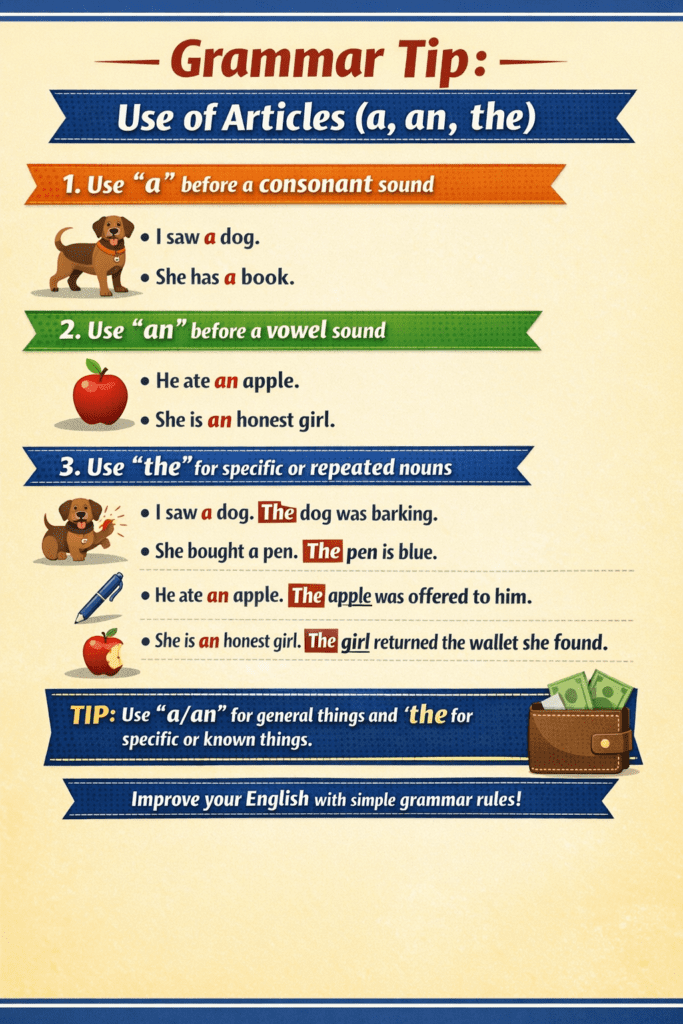
An article is an adjective or a determiner. Like adjectives, articles modify nouns. Learning of uses of articles is very necessary.
There are two types of articles in English. Definite article and indefinite article.
Uses of Articles
Articles are used before nouns.
Articles: Definite(the ) and indefinite(a/an)
Definite article ‘The’ is used to refer to specific or particular nouns; indefinite article a/an is used to modify non-specific or non-particular nouns.
the = definite article
a/an = indefinite article
Observe the following sentences and learn the uses of Articles. 1. We celebrate our Independence Day on the fifteenth of August. 2. The highest range of mountains in the world is the Himalayas. 3. The Taj Mahal attracts a lot of tourists every year. 4. The Ganga is a holy river but it is not in Maharashtra. 5. The distance from the sun to the earth is 149.6 million kilometers. 6. Yesterday I saw a European riding an elephant. 7. Driving a boat is not the same as driving a car. 8. The Women’s Organisation raised the same problem.
9.The rich should help the poor. 10.The sun sets in the west. 11. He goes to church for offering prayers. 12. My mother has gone to a hospital to visit a sick relative. 13. I feel tired as I went a bed late last night. 14. I went to a church to see the carvings. 15. A stranger went to the School to complain about the behavior of one of the pupils. 16. He was found guilty of theft and sent to Prison for six months. 17. If you are seriously ill, you will have to go hospital.
Lets study Articles: Definite and indefinite
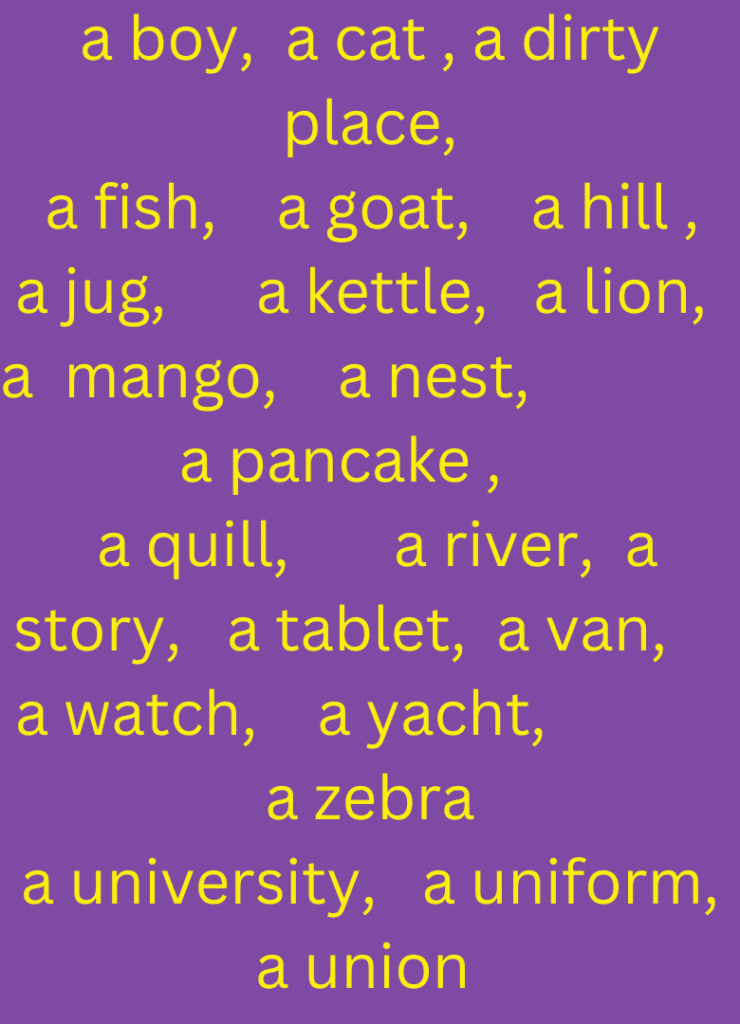
Look at the following words with indefinite article ‘a’. Indefinite article ‘a’ is used before nouns. Nouns are arranged alphabetically to get the idea about the use of articles.
a boy a cat a dirty place a fish a goat a hill a jug a kettle a lion a mango a nest a pancake a quill a river a story a tablet a van a watch a yacht a zebra a university a uniform a union
Look at the following words with indefinite articles ‘an’.
an apple
an M.P.
an elephant
an honest man
an inkpot
an honourable man
an orange
an M.B. A. degree
an umbrella
an heir
an M.L.A.
The words show that a singular common countable noun takes indefinite article 'a' or 'an' . Those beginning with consonant sound (not letter) take 'a' before them. Those beginning with vowel sound (not letter) take 'an' before them.
Articles: Definite and indefinite
Observe the use of definite article ‘the’ in the following extract.
The United Kingdom is an island surrounded by the English Channel, the Atlantic, the Irish Sea and the North Sea. It is made up of four regions: England, Scotland, Wales and Northern Ireland, and although London is the capital of whole country, each region has its own capital city (London, Edinburgh, Cardiff and Belfast). The best-known rivers are: the Thames, the Severn, the Humber and the Mersey. The highest mountains in the United Kingdom are found in Scotland (the Grampians) and The North Wales (the Cambrian Mountains), while England’s major range is called the pennies. English is spoken everywhere in Britain.
Remember the following 6 tips for the use of definite article
It shows that definite article ‘the’ is used before
1) names of unique things e.g. the sun, the moon, the earth, the sky, the Tajmahal
2) names (proper noun) of ocean, river, island, mountain ranges,historical monuments and holy books e. g. the Indian Ocean, the Pacific Ocean, the Ganga, the Tapi,the Kauvery, the Andman and Nikobar, the Himalayas, the Sahyadris, the Alps, the Rocky, the Red Fort, the Tajmahal, the Bhagwad Geeta, the Quran, the Bible
3) names of musical instruments e.g the guitar, the flute, the sitar, the sarangi
4) before ordinal numbers, superlative adjectives e. g. the first, the second, the fifth, the twelfth, the best, the most beautiful, the tallest
5) before the nouns which is referred earlier: ‘a’ or ‘an’ is used when we refer it for the first time but later on for the same noun we use ‘the’ before it.
e.g. I bought a book. The book had some missing pages.
6) before the adjective that perform the function of noun e.g. The young should come forward to shoulder the responsibility. The rich should help the poor.
More Examples of Definite Article
The sun is shining brightly today.
The moon will rise at sunset tonight.
The wind is blowing from the east.
The children are playing in the park.
The cat is sleeping on the couch.
The mountains in the distance look beautiful.
The book on the shelf is my favorite novel.
The flowers in the garden are blooming.
The dog is barking at the mailman.
The movie theater on the corner is showing a new film.
Insert the article a, an,or the ( definite article or indefinite article )where necessary. Choose x where no article is used.
1) I like …. blue T-shirt over there better than …. red one.
2) Their car runs 150 miles … hour.
3) Where’s … USB drive I lent you last week?
4) Do you still live in ……Bristol?
5) Is your mother working in ……. old office building?
6) Carol’s father works as …….electrician.
7) The tomatoes are 99 pence …… kilo.
8) What do you usually have for …… breakfast?
9) Ben has ….. terrible headache.
10) After this tour you have ……. whole afternoon free to explore ……. city.
Key
1) I like the blue T-shirt over there better than the red one. 2) Their car runs 150 miles an hour. 3) Where’s the USB drive I lent you last week? 4) Do you still live in x Bristol? 5) Is your mother working in an old office building? 6) Carol’s father works as an electrician. 7) The tomatoes are 99 pence a kilo. 8) What do you usually have for x breakfast? 9) Ben has a terrible headache. 10) After this tour you have the whole afternoon free to explore the city.
Exercise on Articles: Definite and indefinite
Fill in the correct article (A , AN or THE) where necessary – or leave blank ! 1. _______ moon goes round _______ earth every 27 days. 2. The Soviet Union was _______ first country to send a man into _____ space. 3. Did you see the film on _______ television or at _______ cinema? 4. I’m not very hungry, I had _______ big breakfast. 5. I never listen to _____. radio. In fact, I haven’t got _______ radio. 6. What is _______ highest mountain in _______ world? 7. It was a long voyage. We were at _______ sea for four weeks. 8. Look at _______ apples on that tree. They’re very large. 9. _______ women are often better teachers than _______ men. 10. In Britain _______ coffee is more expensive than _______ tea. 11. We had a very nice meal. _______ cheese was especially good. 12. They got married but _______ marriage wasn’t very successful. 13. I know someone who wrote a book about _______ life of Gandhi. 14. _______ life would be very difficult without _______ electricity. 15. _______ Second World War ended in 1945.
16. Do you know _______ people who live next door? 17. Are you interested in _______ art or _______ architecture? 18. Don’t stay in that hotel. _______ beds are very uncomfortable. 19. I hate _______ violence. 20. John himself doesn’t go to _______ church.
21. After _______ work Ann usually goes home. 22. When Ann was ill, we went to _______ hospital to visit her. 23. _______ British Prime Minister lives in _______ Downing Street 10. 24. _______ Tate Gallery is the main modern art museum in London. 25. Have you ever visited _______ Tower of London? 26. Do you know _______ time? Yes, _______ clock in _______ hall has just struck nine. 27. I am on _______ night duty. When you go to _______ bed, I go to _______ work. 28. There will always be a conflict between _______ old and _______ young. _______ young people want _______ change but old people want _______ things to stay _______ same. 29. In the past _______ most young boys became a farmer or got another job in their village. 30. _______ city life is very noisy, hectic and dirty.
31. The waste gases of cars and factories are the primary reasons for _______ air pollution. 32. People only have parks, where they can enjoy _______ nature. 33. At the beginning I spoke about _______ tourism in _______ towns. 34. It’s right that there aren’t so many ways of spending _______ daily life in _______ suburbs. 35. But is it still true that the countryside is praised to be _______ best place for living. 36. But when you live in _______ solitude you are not always happy
Fill in blanks with a, an or the.
i. My effort was over and I collapsed almost unconscious, with –––– (1) arm on either side of me. It was only then that real pain overtook me. I felt like –––– (2) exploded flashlight with no will to live; I just went on existing in –––– (3) most passive physical state without being quite unconscious. ii. It was –––– (4) capital idea of mine. But I haven’t –––– (5) instant to lose. First of all, let me put Mr. Cox’s things out of Mr. Box’s way. Now then, to put –––– (6) key where Mr. Cox always finds it. iii. You must cross –––– (7) Atlantic to go to –––– (8) U.S.A. iv. Lynda is _ (9) Australian, but her husband is _ (10) European.
1.(A) Fill in the blanks with appropriate articles: –
(i) This is _ book I want. the (ii) My uncle is—— doctor. a (iii) She is ——–untidy girl. an (iv) This is ——-best book on the subject. the (v) Please wait ——–minute. a (vi)Twelve inches make ——-foot. a (vii) He enjoyed—– lunch. the (viii) He is —-M.A. in English. an (ix) Future turns like ——wheel. a (x) __ cow is a useful animal. A
1. (A) Fill in the blanks with suitable articles:
1. _____ cow is a useful animal.
2. It was _____largest ship.
3. One evening _____ beggar came to my door.
4. Sri Lanka is _____ island.
5. There is ____ horse in the field.
6. Gardening is ______ good hobby.
7. He is _____ M.P.
8. He is ——–M.L.A. of this area.
9. There is ___ white tiger in the zoo.
10. What is ___exact cause of illness?
11. ___pen is mightier than the sword.
12. It is ___easy task.
13. China is to ____north of India.
14. ___ dog is a friendly animal.
15. Picasso was____artist.
16. My cousin is___Surgeon
17. ____Americans earn more money.
18. It was __ honour to meet you.
19. The horse is ___noble animal.
20. The rose is___ sweetest of all flowers.
Fill in the blanks with suitable prepositions.
1.Jack is senior ______ Fred.
2. I have known him ______ five years.
3. The boy is suffering _______ fever.
4. He has many pencils ______ his bag.
6. Put this picture ______ the wall.
5. It has been raining ______ yesterday.
7. I am not afraid _____ dog
8. Let’s meet____ six o’clock.
9. I am not afraid ____dog.
10. I went to Scotland_____1980.
11. I was looking ____my lost key.
12. We ran_____ the bushes.
13. My sister looks____ my grandmother.
14. He sat ____ the chain.
15. I prefer coffee_____ tea.
16. She is fond ___ music.
17. We should have complete faith _____ God.
18. He has many pencils ___ his bags.
19. Distribute these chocolates ____ all poor children.
20. I go to school _____ bus.
A. Fill in the blanks with suitable articles:
1. A cow is a useful animal. 2. It was the largest ship. 3. One evening, a beggar came to my door. 4. Sri Lanka is an island. 5. There is a horse in the field. 6. Gardening is a good hobby. 7. He is an M.P. 8. He is the M.L.A. of this area. 9. There is a white tiger in the zoo. 10. What is the exact cause of illness? 11. The pen is mightier than the sword. 12. It is an easy task. 13. China is to the north of India. 14. A dog is a friendly animal. 15. Picasso was an artist. 16. My cousin is a surgeon. 17. Americans earn more money. 18. It was an honor to meet you. 19. The horse is a noble animal. 20. The rose is the sweetest of all flowers.
B. Fill in the blanks with appropriate prepositions:
1. Jack is senior to Fred. 2. I have known him for five years. 3. The boy is suffering from fever. 4. He has many pencils in his bag. 5. It has been raining since yesterday. 6. Put this picture on the wall. 7. I am not afraid of dogs. 8. Let’s meet at six o’clock. 9. I am not afraid of dogs. 10. I went to Scotland in 1980. 11. I was looking for my lost key. 12. We ran through the bushes. 13. My sister looks like my grandmother. 14. He sat on the chair. 15. I prefer coffee to tea. 16. She is fond of music. 17. We should have complete faith in God. 18. He has many pencils in his bag. 19. Distribute these chocolates among all poor children. 20. I go to school by bus.
A report is a written account of something that one has observed. It is a systematic presentation of facts and findings of an event. Reports are used as a form of written assessment. Generally, two types of reports are asked in the exam, namely, newspaper report or a magazine report. Newspaper report is the one which is published in a newspaper and magazine report is generally written for a school magazine.
Report Writing Format
Heading– A descriptive title which is expressive of the contents of the report. By line– Name of the person writing the report. It is generally given in the question. Remember, you are not supposed to mention your personal details in your answer. Opening paragraph (introduction) – It may include the ‘5 Ws’ namely, WHAT, WHY, WHEN and WHERE along with WHO was invited as the chief guest. Account of the event in detail– The proper sequence of events that occurred along with their description. It is the main paragraph and can be split into two short paragraphs if required.
Report Writing Examples
Q1. JNV School, Awalpur, recently celebrated an annual day. You are Amit/Amita Raazdan, editor of the school magazine. Write a report on the event for your school magazine. (120 – 150 words)
Annual Day Celebration HeldAmit Raazdan
Annual Day Celebration was held at JNV Awalpur on 5 Nov 2017 with pomp and enthusiasm.
Dr Mohaan Gokhale presided over the inaugural function. Dr. Anil Chitade Exam Controller Gondwana University was the chief guest on the occasion. Prof Ashish Derkar was the key note speaker. At the outset the guests lighted the traditional lamp and garlanded the photos of Savitribai Fule and Mahatma Gandhi. A group of students presented a welcome song. After the formal welcome of the dignitaries of the dais, the Principal Giridhar Bobade made an introductory speech in which he narrated the growth of the institute. In his speech Dr Anil Chitade urged students to be updated in the age of competition. Further he stated to set the goal and follow it. Prof Ashish Derkar threw light over the personality development. Student presented various cultural activities on the occasion. Hima Das conducted the programme and Prachi Khade proposed a vote of thanks.
Report on ANNUAL SPORTS MMEET
25 December
The Fourteenth Annual Sports Day of AVN, CHANDRAPUR was celebrated on 24th December, 2017 amidst great mirth, enthusiasm and pomp. Sudhirbhau Munghantiwar Hon’ble Finance Minister, Maharashtra, Shri Amresh Kumar Mishra, IPS, Superintendent of Police, -Chandrapur Capt. (Shri) Rudra Sen Sindhu, Chairman, Maratha Education Foundation, Nagpur, were the Chief Guests in various phases of the Meet. Present on the occasion, were Dr. Prakash Amate, Director Lok Biradari Prakalp Hemalkasa, Shri Vijay Varma, Vice Chairman, Members of the PTA, Press and Parents. The Guests were welcomed with bouquets. The Principal welcomed the guests and gathering formally and read a brief report of the school’s sports activities and the students’. The Chief Guests lighted the flame at altar.
March pass was followed by the track events including 4 races by the Primary Wing and 100 mts. Sprint for boys and girls of Middle & Senior wing as well as 4×100 mts. Relay Race for both boys and girls of the Senior Wing. The Chief Guest, Hon. Sudhirbhau Munghantiwar in his address was superlative in his praise for the March past done by the students stating that it was outstanding and well synchoronised. He lauded the energy zest and vitality of students presenting the Field Displays. He opined that the sports is a very important part of education because it makes students disciplined. He urged students to participate in sports with sincerity. The Dr Ambedkar House was adjudged the Best House, in the March Past and the overall Best House is Dr Homi Bhaba House in sports events. The zealous parents, gathered in large numbers, constantly applauded the participants of the Field track displays. The programme was co-ordinated and compered by Mrs. Ambika Kolhe, Incharge Activities, the student anchors were Rupa Nagrale, Menon Radha and Mala Hajate. The Vote of thanks was proposed by Mr. Prashant Pawar. The Meet concluded with the National Anthem.
Children’s Day was celebrated in your school. Write a report on the function in 120 – 150 words describing all the activities that took place. You are Head boy/Head girl.
Children’s Day Celebrated Gadchandur Nov 14 Children’s Day was celebrated with fervor to mark the birth anniversary of Pandit Jawaharlal Nehru today at Mahatma Gandhi Vidhyalaya and Jr. College, Gadchandur.At the outset , the Principal Giridhar Bobade lighted the traditional lamp and garlanded the photographs of Pandit Jawaharlal Nehru and Mahatma Gandhi. In his introductory speech, vice-principal Sharad Jogi threw light over the life of legendary man Pandit Nehru. Tiny tots from middle school were very much eloquent speaking about Panditji. Principal Bobade in his presidential speech urged children to inculcate punctuality and time management of Pandit Nehru.On the occasion science exhibition was arranged wherein 50 children presented their scientific models under the guidance of science teachers. Ashish Derkar compered the program whereas Sau Bharati Ghonge proposed a vote of thanks.
Prize Distribution Ceremony Chandrapur, Sept 23 Navdurga Utsav samiti is organising felicitation and Prize distribution ceremony on the occasion of Navratri festival on September 29 at Chavdeshwari Sabhagruha, Chavdeshwari Square, near Nandavan Police Station. The event will be held at 6 pm onwards. Dr Girish Gandhi will be the chief guest of the programme Renowned poet Asha Pande be the special guest of the event. Subodh Dharmadhikari, Balasaheb Deshmukh, Sanjay Jariwala, Mohanrao Kashikar, Shivling Patwe and Ram Anand Thengni will honour students during the programme. Tanaji Wanve and Harish Dikondwar will also share the dais. Book ‘Pausprashna’ will be released during the event.
The Rising of the Moon is a one-act play written by Lady Gregory. It is an Irish nationalist drama that explores themes of duty, identity, and patriotism.
Plot Summary:
The play takes place at night near a harbor in Ireland, where a Sergeant and two policemen are searching for a fugitive, a rebel who has escaped from prison. A large reward has been announced for his capture. The Sergeant is tasked with guarding the area, while the other policemen go away to search elsewhere.
A ragged ballad singer appears, carrying a bundle of ballad sheets. He strikes up a conversation with the Sergeant, who initially sees him as an ordinary traveler. The singer asks about the escaped prisoner and tells the Sergeant that the fugitive might disguise himself as a singer like him.
As they talk, the singer sings patriotic songs about Ireland’s fight for independence. The Sergeant, who once had nationalist feelings in his youth, is reminded of his past ideals. The singer gradually reveals that he is actually the escaped rebel, but instead of arresting him, the Sergeant hesitates. The singer convinces him that they are both Irishmen and that their country’s freedom is more important than his duty as a policeman.
When the other policemen return, the Sergeant does not reveal the fugitive’s presence. He allows him to escape, choosing his national identity over his official duty.
Themes:
1. Nationalism vs. Duty – The Sergeant faces a moral conflict between his duty as a policeman and his loyalty to Ireland.
2. Identity and Transformation – The Sergeant changes from a loyal officer to someone who sympathizes with the rebel cause.
3. Persuasion and Influence – The rebel’s words and songs influence the Sergeant’s emotions and decisions.
Conclusion:
The Rising of the Moon is a powerful story about patriotism and moral choices. It highlights how personal beliefs can sometimes challenge professional responsibilities. The Sergeant’s decision to let the rebel go symbolizes a shift from being a servant of colonial rule to embracing his Irish identity.
Textual Activities on the Rising of the Moon
1.Find out the reason of the man for staying at the place.
Ans: To make a few shillings the man stayed at the place.
2. The stranger stays with the Sergeant. Find a way …… by him to allow him.
ANS: The stranger stays with the Sergeant by telling him that he would wait for sailors. The sailors would buy a ballad off him.
3. Write about the persuasive approach of the man? Ans: The man wanted to stay at quay .He persuades the sergeant to allow him to sit on the steps .Then he tells the sergeant that he knows the man he is waiting for.
4.The man and the Sergeant need each other’s support. Find such examples. Ans: The following conversation shows they need each other’s support Sergeant : You know him? Come back here. What sort is he? Man : Come back is it, Sergeant?
5. The man tries to enforce the Sergeant in favour of the criminal Find the sentence from the text. Ans: I wouldn’t be in your shoes if the reward was ten times as much.
6. Find the life of the singer that is mentioned in the extract. ANS : He is a poor man. He sings on the streets and in fairs. He walked through the hills to view rocks and streams.
7.The wavelength of the man and the Sergeant goes together find the evidences from the text. Ans: The man sings patriotic songs. The Sergeant remembers the songs.
8. The discussion about patriotic songs goes on. Find the points from the extract. Ans: When the man
9. There is a reference of a criminal. Find sentences in the context and write
Ans: breaking goal and hiding in the dark, myself would be trying maybe to put a bullet in his head, or to take up a lump of a stone the way you said he did
BRAINSTORMING on the Rising of the Moon
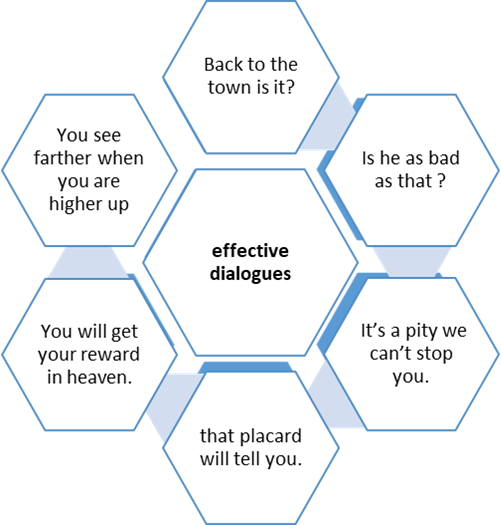
(A1) There are some dialogues which are short, but quite effective. They give us enjoyment and add beauty to the main story. Find some more from the text.
rising of moon
The Rising of the Moon
(A2) Activities on Theme element of the Rising of the Moon
(i) Comment on the given statement after reading the given dialogue- a. And if we get him itself, nothing but abuse on our heads for it from the people, and maybe from our own relations-you may begin like this
We do not think about society at large because people do not understand how difficult time we face in force. They abuse us even if we obey the orders.
b. It’s a pity some honest man not to be better of that.
c. I wouldn’t be in your shoes if he reward me ten times as much. People generally fall victim to incentives. Some people stick to values. They do not give importance to reward but the nationalism.
d. But when I saw a man in trouble, I could never help trying to set him out of it. Its human to help others. Here the statement tells us that we should help the people in trouble to come out of it.
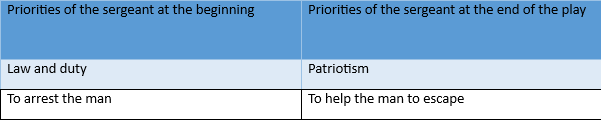
(ii) The priorities of the Sergeant are shifted. Complete the given table by using the given clues. Priorities of the sergeant at the beginning Priorities of the sergeant at the end of the play
Find sentences from the play the rising of the moon related to the given points. a. Loyalty in Irish Nationalism: (1) May be Sergeant you’ll be on the side of the country yet. (2) I am thinking it was with the people you were, (3) In spite of your belt and your tunic, that it might have been as well for you to have followed Granuaile. (4) Sergeant puts hat and wig behind his back.
b. Tension between different loyalties
(1) It’s little we get but abuse from the people, and no choice but to obey our orders. (2) Indeed it’s a hard thing to be in the force, out at night and no thanks for it, (3) But when I saw a man in trouble, I could never help trying to set him out of it. (4) There’s many a thing a man might know and might not have any wish for.
(i) Theme of The Rising of the Moon
The play by Lady Gregory shows the conflict between duty and patriotism. The sergeant must arrest a rebel but feels sympathy for Ireland’s freedom struggle. Influenced by patriotic songs, he chooses humanity over duty, highlighting that national identity and conscience are stronger than official responsibility.
(ii) Character Sketch of the Sergeant The Sergeant is a dutiful British officer but an Irishman at heart. He is responsible, practical, and experienced. As he listens to patriotic songs, his hidden nationalism awakens. Facing a moral conflict, he finally helps the rebel escape, showing compassion and love for his country over strict duty.
(A5) The description of the character from the rising of the moon is given below. Identify the character from the play. Find some sentences which support your choice. (a) He is a brave but irresponsible person. Ans The character is the Sergeant. He is brave – I don’t want it. Bring it with you, He is irresponsible Sergeant (after a pause) – no one. (b) He is a major character. He dominates in the story. (1) Character : Man , A ballad singer : Jimmy Walsh a man who broke the jail (2) A story is woven around the a ballad singer. (c) He is smart as well as brave. (1) Character: Man (2) Proof : You might be standing there, looking out that way, thinking you saw him coming up this side of the quay (points), and he might be coming up this other side (points), and he’d be on you before you knew where you were. (d) He is the centre of the play. (1) Character : Man (2) (e) He is obedient and simple. (1) Character : Sergeant