Home Blog Page 47

The Inchcape Rock Std 12: Solution to Brainstorming

20
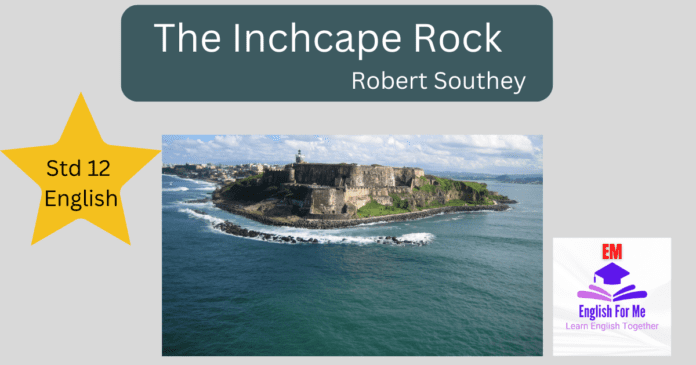
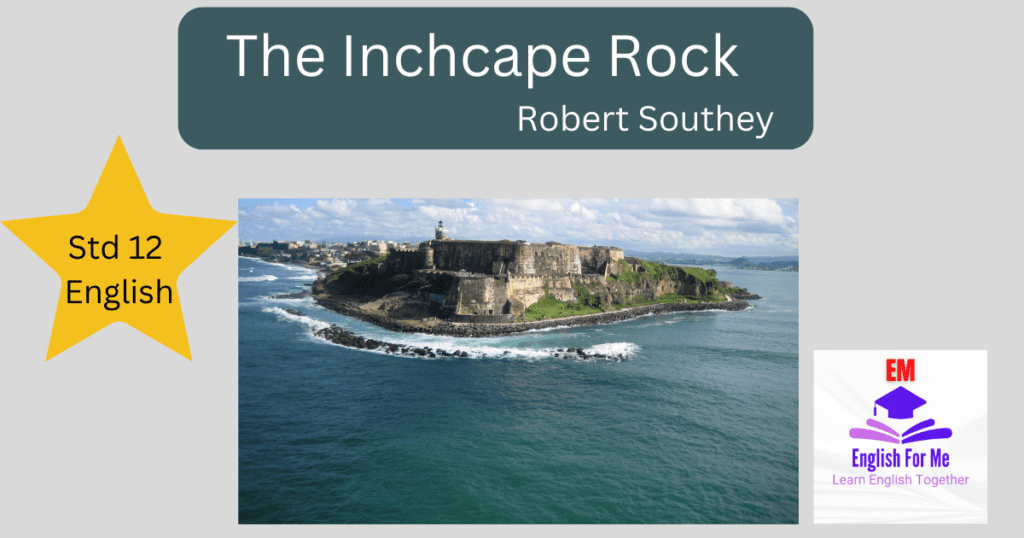
the Inchcape rock
The Inchcape Rock Std 12: Solution to Brainstorming

Vocabulary on The Inchcape Rock

stir – हालचाल

sail – समुद्रपर्यंटन

motion – गती

keel – जहाजाचे तड

steady – स्थिर

waves – लाटा

buoy – तरंगती वस्तू

floated – तरंगले

swung – हेलकावा घेतला ( swing) 

hid – लपलेलं

surge – लाट

Swell – विस्तारने

mariners – खलाशी

perilous – धोकादायक

scream – किंचाळने

mirthful – आनंदी

wickedness – दृष्टपणा

row – नौका वल्हवणे

plague – दुखावणे

sunk – बुडाले , डुबले 

scoured – जिक्रीचा प्रवास केला

steers – जहाज चालविणे 

haze – धुके

gale – वादळ

drift – हळुहळु पुढे जाणे

vessel – जहाज

shivering – थरकाप

tore – उपटले

despair – निराशा

tide – भरती

The Inchcape Rock Paraphrase

There is no stir in the air and sea. The ship was not moving. It was calm and steady. The waves flowed silently over the Inchcape rock. They had no fall and rise. So the Inchcape rock was not seen . So it became Perilous rock. The bell was put on the Inchcape Rock by the Abbot of Abrbrothok to save the ships from wrecking. The bell would flout and swing. It would ring the warning bell. The mariners blessed the Abbot of Abhorbrothak. One day out of jealousy Sir Ralph cut the bell and threw it in the sea. He sailed away. He amassed wealth looting the marines and returned. In his return journey it was dark. They could not see land. They could not see the inchcape rock and the ship wrecked and drowned. 

हवा आणि समुद्र अगदी स्थिर आहेत. जहाज हलत नव्हते. ते शांत  आणि स्थिर होते. इंचकॅपे खडकावर लाटा वाहू लागल्या. त्यामुळे इचकेप रॉक नजरेस पडत नव्हता. जहाजांना बुडण्यापासून वाचवण्यासाठी अब्बोट अबॉर्ब्रोथक ने एक घंटा इंचकॅपे रॉक वर ठेवली होती. बेल फडफडत घुमायची व चेतावनी घंटा दयायची. त्यामुळे नाविकानी अबोरर्ब्रोथकच्या मठाधिपती आशीर्वाद देण्यास सुरुवात केली. एके दिवशी मत्सराच्या बळावर सर राल्फ ने घंटा कापली आणि ती समुद्रात फेकली. तो निघून गेला. त्याने समद्रुीजहाज लुटून संपत्ती जमवली आणि परत आला. परतीच्या प्रवासात काळोख होता. त्यांना जमीन दिसत नव्हती. त्याांना इांचकेप खडक दिसला नाही आणि जहाज कोसळले आणि बुडाले

Summary

“The Inchcape Rock” by Robert Southey is a narrative poem that tells the story of an act of treachery and its eventual consequences. The poem recounts how Sir Ralph the Rover, a ruthless pirate, removes a warning bell from the Inchcape Rock, a dangerous reef in the North Sea. By doing so, he hopes to lure ships to their destruction and plunder their cargo.However, Sir Ralph’s deceitful actions come back to haunt him when, years later, he navigates the same waters and his own ship falls victim to the submerged reef, resulting in its destruction. As punishment for his misdeeds, Sir Ralph and his crew perish in the disaster, serving as a cautionary tale about the perils of greed and betrayal.”The Inchcape Rock” explores themes of karma, poetic justice, and the consequences of one’s actions. It emphasizes the importance of integrity and the belief that ultimately, wrongdoing will be met with retribution.

Brainstorming for “The Inchcape Rock” by Robert Southey

1. Themes

  • Good vs. Evil – The poem contrasts the noble Abbot of Aberbrothok with the wicked Sir Ralph the Rover.
  • Karma and Poetic Justice – Sir Ralph removes the warning bell and later perishes as a result.
  • Greed and Recklessness – Sir Ralph’s selfish actions lead to his downfall.
  • Fate and Divine Justice – The ocean and nature seem to punish wrongdoers.

2. Key Characters

  • The Abbot of Aberbrothok
    • A wise and kind-hearted man.
    • Places the warning bell on the Inchcape Rock to save sailors.
  • Sir Ralph the Rover
    • A pirate driven by greed and mischief.
    • Removes the bell to cause shipwrecks for personal gain.
    • Ultimately, he falls victim to his own trick and drowns.

3. Symbolism

  • The Inchcape Bell – Represents safety, wisdom, and the power of good intentions.
  • The Stormy Sea – Symbolizes fate and divine punishment.
  • Sir Ralph’s Shipwreck – Illustrates poetic justice; he suffers the same fate he intended for others.

4. Structure and Style

  • Ballad Form – The poem is written in a rhythmic and musical style, making it memorable.
  • Dramatic Narrative – A clear storyline with suspense, conflict, and a moral lesson.
  • Repetition and Imagery – Enhances the poem’s impact (e.g., descriptions of the calm sea turning violent).

5. Irony in the Poem

  • Sir Ralph laughs when he removes the bell, believing he has outwitted the Abbot.
  • In the end, he is doomed by the very danger the bell was meant to prevent.

Brainstorming on The Inchcape Rock

(A1) Narrate in groups the scene described in the beginning of the poem.

Ans:  In the beginning the silent sea is described. There was no stir in the air. There were no waves in the sea. The ship had no motion. The keel of the ship was steady in the ocean. The waves were too slow to move the Inchcape bell.

(A2) (i) Complete the following statements.

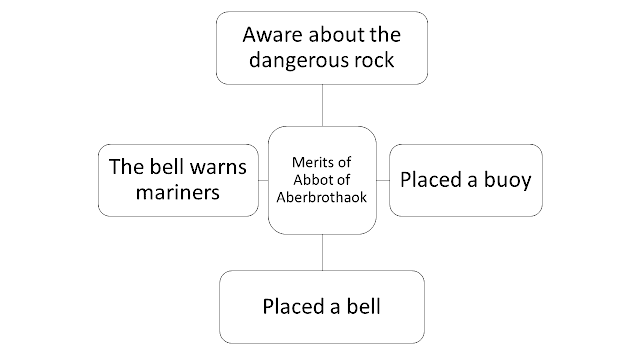
(a) The Abbot of Aberbrothok placed a bell on the Inchcape Rock because..      he thought the bell would warn the mariners about the dangerous rock. 

(b) The mariners were grateful to the Abbot of Aberbrothok because………… the bell placed by him warns them about the dangerous rock.

(c) The result of the thick haze that covered the sky was that………….. they could see neither the sun nor the land.

(d) The Rover in frustration pulled his hair and cursed himself because…….. the waves and rushed on all sides and his ship was sinking.

(ii) Given below are the events that give the theme of the poem in a jumbled form. Arrange in a proper sequence as per their occurrence.

(a) The waves were so small that they did not move enough to ring the bell at the Inchcape Rock.

(b) The Abbot of Aberbrothok had placed the bell on a buoy on the rock.

(c) There was a thick haze spread over the atmosphere.

(d) Ralph bent over from the boat.

(e) Sir Ralph cursed himself in despair and in his frustration tore his hair.

  • Ans:  The Abbot of Aberbrothok had placed the bell on a buoy on the rock. 
  • The Abbot of Aberbrothok had placed the bell on a buoy on the rock.
  • Ralph bent over from the boat. 
  • There was a thick haze spread over the atmosphere.
  • Sir Ralph cursed himself in despair and in his frustration tore his hair.

(iii) Describe the qualities of the Abbot of Aberbrothok in your own words.

Benevolent, Fore sighted, Big-hearted,Noble, Philanthropic, Kind

(v) ‘Jealousy’ is the most incurable defect. Justify.

Ans :  Sir Ralph developed jealousy for the Abbot of Aberbrothok who placed the bell on the Inchcape Rock. The mariners blessed the Abbot for this. Sir Ralph became jealous of him. Out of jealousy he cut the bell. On his return journey he failed to identify the perilous rock and sank.

(v) ‘But the Rover’s mirth was wickedness’. Explain this line in your own words with the help of the poem.

Ans :  The Rover was cheering and whistling out of wickedness. He had planned to cut the bell on the Inchcape Rock out of jealousy for Abbot of Aberbrothok. He asked his crew to row the boat to the Inchcape Rock. Then he cut the Bell . 

(A3) Some words in the poem are related to different parts of a ship or a mariner’s life. Given below are the meanings of those terms. Identify the word.

(a) Helps in steering the ship – row / steers

(b) The lowest part of the ship – keel

(c) Floating object that shows direction – buoy

(d) Another name for a ship – boat

(e) Sinking sound – gurgling

Figures of Speech

(ii) Select the appropriate figure of speech from the box given below and complete the table.

Examples Figure of speech Explanation
1. Sir Ralph the Rover torehis hair.AlliterationThe close repetition of consonant sounds at the beginning of words
2. No stir in the air no stir inthe sea..RepetitionThe words are repeated pleasingly.
3. On a buoy in the storm it floated and swungInversionThe line is not in a correct prose order.
4. Down sank the bell with a gurgling soundOnomatopoeiaGurgling represents the sound of drowning.
5. The devil below was ringing his knell. MetaphorThe devil is implicitly compared with death and knell with life.
6. The ship was as still as she could be.PersonificationThe ship is treated as person by using feminine gender.
7. On the deck the Rover takes his stand.InversionThe line is not in a correct order.
8. Oh Christ !ApostropheChrist is directly addressed.
Figures of Speech from The Inchcape Rock

Audio of the poem

Listen the given extract.

Activity One : Questions and Answers

Q.3 (A) Read the given extract and complete the activities given below: (10)
No stir in the air, no stir in the sea,
The Ship was still as she could be;
Her sails from heaven received no motion,
Her keel was steady in the ocean
Without either sign or sound of their shock,
The waves flow’d over the Inchcape Rock;
So little they rose, so little they fell,
They did not move the Inchcape Bell.
The Abbot of Aberbrothok
Had placed that bell on the Inchcape Rock;
On a buoy in the storm it floated and swung,
And over the waves its warning rung.
When the Rock was hid by the surge’s swell,
The Mariners heard the warning Bell;
And then they knew the perilous Rock,
And blest the Abbot of Aberbrothok.


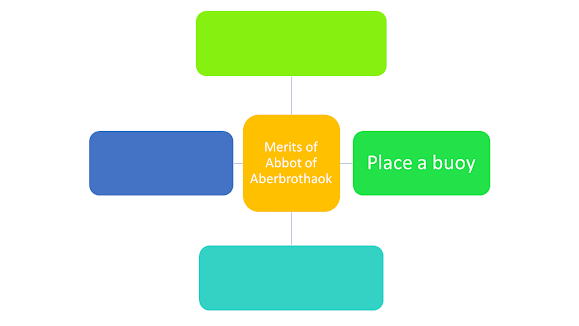
A1 Complete the web. (02)
The Inchcape Rock Std 12: Solution to Brainstorming
The Inchcape Rock

Ans : 

the Inchcape rock


A2 Give reasons. (02)

Abbot of Aberbrothok placed a bell on the Inchcape rockbecause………………………………………………………………………………..

Ans: Abbot of Aberbrothok placed a bell on the Inchcape rockbecause the Inchcape rock is a dangerous rock. When the waves swell, the rock is hidden. Mariners fail to identify the existence of the rock and fail to avert the accident. Abbot of Aberbrothok  placed the bell to warn the people about the Inchcape rock. 

A3 If you were Abbot of that era, what would you do to make the ship safe from crashing atInchcape rock. (02)

Ans: If I were Abbot of that era, I would have spread floating object around the Inchcape rock. I would have arranged warning message to be delivered as soon as a ship arrives in the vicinity of the rock.

 A4 Complete the table. (02)

Ans:

Examples Figure of SpeechExplanation
1.The Ship was still as she could be——–——–

2. No stir in the air, no stir in the sea 
——–———

Examples
      Figure of Speech                    
Explanation
1.The Ship was still as she could be.    Alliteration  The consonantal sound ‘sh’ is repeated pleasingly.                                  
2. No stir in the air, no stir in the sea 
   Refrain     The line is repeated effectively.


A5 Compose a short poem. 
No stir in the air, no stir in the sea,………………………………………………………………………….Her keel was steady in the ocean.
Ans: No stir in the air, no stir in the sea,Cloud clean and clear seen by meThe ship was on her mission Her keel was steady in the ocean.

Click here for Have You Earned Your Tomorrow

Activity 2


A1 True/False

1. The ocean was silent.

2. The ship was sailing fast.

3. The waves were rising high.

4. The Abbot of Aberbrothok had placed the bell on the Inchcape Rock.

A2. State the importance of the bell on the Inchcape Rock.

A3. Suggest solution to warn people about the dangerous place in the ocean.

A4. No stir in the air, no stir in the sea. Name and explain the figures of speech. Find a similarexample.

A5. Write four lines about the benevolent deed of your friend.
B. Read the extract and complete all the activities given below.

Extract : The buoy of the Inchcape………….. for Scotland’s shore.

A1. Narrate the scene in the first stanza of the extract.

A2. ‘ A darker speck on the ocean green.’ Analyse.

A3. Convince Sir Ralph the Rover not to cut the bell on the Inchcape Rock.

A4. Find out two examples of inversion from the extract.

A5. Write four poetic lines on ‘boat’.

Read Song of the open Road.

Click /touch here for The Cop and the Anthem

Poetic Appreciation

Write a poetic appreciation of the poem 2.3 ‘The  Inchcape Rock’ with the help of the following points. 


·       

About the poem / poet and the title·       

The theme·       

Poetic Style·       

Language /Poetic devices·       

Special features·       

Message, values, morals in the poem·       

Your opinions about the poem                               

2.3 The Inchcape Rock‘The Inchcape Rock’ a ballad is written by Robert Southey. He was a poet Laureate of England. ‘The Inchcape Rock’ is a very popular poem with the school children. It is about attempt by the Abbot of Aberbrothok to install a warning on Inchcape and removal by a pirate, Ralph. The pirate met with an accident on the same rock in his return journey.The poem is in the form of ballad. It tells a story. The poem is dramatic and narrative. There are seventeen stanzas of four lines each. The poem follows the rhyme scheme aabb.The poet Robert Southey has used vivid words. It creates mental pictures. The poem seems to be live pictures. Some words are repeated and created a soothing effect. The poem is enriched with poetic devices such as alliteration, repetition, inversion, onomatopoeia, metaphor, personification, simile and apostrophe.The poem gives us a message that those who do wrong things will meet with due punishment.

Indian Weavers : New Guide Std 12

8
Indian Weavers

Std 12 Englsih New Course

Paraphrase – Indian Weavers by Sarojini Naidu

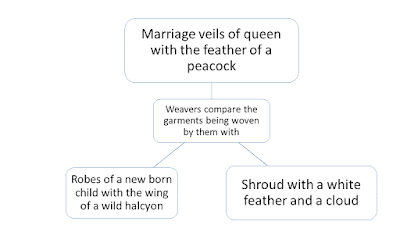
Weavers are weaving a garment early in the morning. They are so happy. They are weaving the robes of a new born child. The robes are blue as the wings of a Kingfisher. In the evening weavers are weaving a bright garment. The garment is like the bright soft feathers of a peacock. It is the marriage veil of a queen. Weavers are solemn and still at the chill night. They are weaving the shroud for a dead man’s funeral. The garment is as white as feather and cloud. 

Vocabulary

weavers – विणकर

Garment – वस्त्र

gay – आनंदी

robes- झगा

plumes – पंख

veil – ओढणी

solemn – गंभीर

shroud – प्रेतवस्त्र

funeral – अंत्यविधी संबंधी

Indian Weavers Paraphrase

विणकर सकाळी लवकर कपडे विणतात. ते खूप आनंदित आहेत. ते नवीन जन्मलेल्या मुलाचे वस्त्र विणतात. संध्याकाळी विणकर एक चमकदार पोशाख विणतात. वस्त्र मोराच्या चमकदार मऊ पंखांसारखे आहे. हे एका राणीच्या लग्नाचे बुरखे आहेत. विणकर गारठलेले आहेत. थंडगार रात्री आहेत. ते मृत माणसाच्या अंत्यसंस्कारासाठी कफन विणतात. वस्त्र पंख आणि ढगाप्रमाणे पांढरे आहे.

Read More:Song of the open road

Summary

“Indian Weavers” by Sarojini Naidu is a poem that celebrates the skill and artistry of Indian weavers. The poem vividly describes the scene of weavers at work, using their looms to create intricate patterns and designs on fabric. Naidu highlights the rhythmic motion of the looms and the hypnotic sound of the shuttles as they weave together threads of various colors. She praises the weavers for their patience, dedication, and craftsmanship, comparing them to artists who create beautiful tapestries out of the simplest of materials. The poem also touches upon the themes of tradition, heritage, and the timeless beauty of Indian craftsmanship. Overall, “Indian Weavers” pays homage to the talent and creativity of these unsung artisans, whose work enriches the cultural tapestry of India.

BRAINSTORMING On Indian Weavers

(A1) Discuss with your partner about the following vocations:

(a) Weaving – Weaving is a method of textile production in which two distinct sets of yarns or threads are interlaced at right angles to form a fabric or cloth.  

(b) Tailoring – A tailoring is a profession in which a person makes, repairs, or alters clothing professionally, especially suits and men’s clothing.

(c) Knitting – Knitting is a method by which yarn is manipulated to create a textile or fabric; it is used in many types of garments

 (d) Embroidering – Embroidering is to decorate cloth or clothing with patterns or pictures consisting of stitches that are sewn directly onto the material

(A2) (i) Discuss the various products made by the weavers in the poem.

Ans: In the poem the weavers made different garments for different people. The weavers wove the robes of a new-born baby, a marriage-veils of a queen and a dead man’s shroud. 

(ii) The words in the three stanzas of the poem mention different times of a day. Complete the table.

Time of the dayWords/phrasesWeaver’s work
Early morningBreak of dayWeavers weave robes for the new-bornchild
Late in the eveningFall of nightThey weave the marriage-veil of a queen.

(iii) The poem reveals three phases of life. Fill in the blanks with feelings and colours appropriate to the phases of life. One is done for you.

New-born/ ChildhoodYouth/AdulthoodOld age/ Death
ColourBluePurple and greenWhite
FeelingHopes and expectationsJoy and delightSadness/ grief 

(iv) Complete:  The weavers weave in the chill moonlight ………..(a dead man’s funeral shroud. )

(v) Pick out two words used to describe the weavers in the last stanza. Also state their importance.

The poet describes the weavers as solemn and still in the last stanza. They are solemn and still because they are weaving a shroud for the dead man. 

(vi) Express your views about the present condition of weavers.

(vii) Describe in your own words the steps or measures that can be taken to

solve the problems of the weavers.

(viii) Express your own views and opinions from the weavers’ point of view and complete the following table.

StanzaActivity (done byweavers)Views/Opinion
First stanzaRobes for a new-born child
The weavers feel gay because their work indicates the beginning full of hope.
Second stanzaMarriage-veil for a brideThey feel excited because their work indicates a new journey of life.
Third stanzaShroud for a dead bodyThey are gloomy because their work indicates the end of life. 

(A3) (i) Pick out the rhyming words from the poem.

Day-gay ; wild-child ; night-bright; green-queen ; still-chill; cloud-shroud.

(ii) Give antonyms and synonyms of the following and make sentences of your

own.

WordAntonymSynonym
newoldlatest
brightdarkshining
deadaliveexpired
stillactivecalm
wildtamefierce
fallriseDrop down
childadultInfant 

The figures of speech found in the poem “Weavers” by Sarojini Naidu:


1. Simile: Comparisons using “like” or “as.”
– “Blue as the wing of a halcyon wild”
– “Like the plumes of a peacock, purple and green”

-“White as a feather and white as a cloud”

2. Personification: Giving human characteristics to non-human entities.
–

3. Metaphor: Implied comparisons without using “like” or “as.”
–

4. Alliteration: Repetition of consonantal sound

– Why do you weave a garment so gay?

– Weavers, weaving solemn and still,

– Like the plumes of a peacock, purple and green,

These figures of speech enhance the poem’s imagery and contribute to its overall meaning and emotional impact.

Activity Set 1

Activities on Indian Weavers Std 12 English Poem

A1 

Time of the Day Type of Garment Colour of Garment     For Whom
Early in the Morning………..BlueNew Born Child
…………Marriage vels of QueenPurple and Green……..
In the /dead NightDead Man’s Funeral Shroud…………Dead Man

Ans: 

Time of the Day Type of Garment Colour of Garment     For Whom
Early in the MorningRobes of a new born Child BlueNew Born Child
In the evening Marriage veils of QueenPurple and GreenQueen / Bride
In the dead NightDead Man’s Funeral ShroudWhiteDead Man

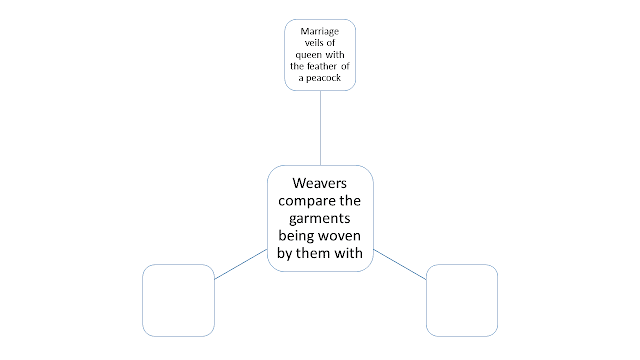
  A2. Complete the following web chart what weavers compare the garments being woven by them.       


Indian Weavers : New Guide Std 12

Ans: 

Indian Weavers : New Guide Std 12


A3. Describe in your words the steps or measures that you would take to solve the problems of weavers. 

Ans: At the advent of textile industry weavers lost their work and wages. I would like to solve their problems by giving them suitable employment. I would appeal people to use handwoven clothes on certain occasions. I would like to help weavers with new technology and fashion. By adopting new measures they will compete with textile industry and get enough wages. 

 A4. The rhyme scheme of the first stanza is abab. Find rhyme scheme of in the second and the third stanza and also write down the rhyming pairs of words. 

Ans:                 Rhyme Scheme             Rhyming words

Second Stanza :     ccdd                         night-bright, green-queen

Third Stanza    :     eeff                          still – chill; cloud – shroud 
A5 Compose four lines on importance of clothes. 
Ans: Importance of Clothes


One of the basic needs is clothes.  
Clothes we wear with much cares
To protect our body from heat, cold And rain.
Some for status to hold.  

Practice Set

Read the extract and do all the activities. For Practice on Indian Weavers

A1 Complete the table showing weavers’ routine.

At break of day ——For new born child
————–Marriage veils. —————
—————shroudFor a dead man’s Funeral
Indian Weavers by Sarojini Naidu

A2. Show the association between the three stages of day and life.
A3 State how parents feel at the time their daughter’s marriage.
A4. Point out the rhyming words and rhyme scheme of the poem.
A5. Create 4 poetic lines on weaving a uniform.

Answers :A1

At break of day Robes For new born child
At fall of night Marriage veils.For a bride
In the moonlight chillshroudFor a dead man’s Funeral
Indian Weavers by Sarojini Naidu

A2. Three stages of the day represents the three stages of life. The morning represents thebeginning of life. The evening represents the adulthood. The chill moonlight night represents the end of life i.e. death.

A3. The parents have mix feeling at their daughter’s marriage ceremony. They are happy thattheir new life begins. They are sad because their daughter is parting with them.

À4 Rhyming words – day- gay wild- child night- bright green – queen still – chill cloud – shroudRhyme scheme : aabb

À5

Weavers, weaving at rising sun
Why do you weave a garment with fun?
With checks and colour mild
We weave the uniform for child.

Indian Weavers by Sarojini Naidu

Poetic Appreciation

Write a poetic appreciation of Indian Weavers with the help of the following points.

  • ·       About the poem / poet and the title
  • ·       The theme
  • ·       Poetic Style
  • ·       Language /Poetic devices
  • ·       Special features
  • ·       Message, values, morals in the poem
  • ·       Your opinions about the poem

Sarojini Naidu is known as the Nightingale of India because of her poetry. ‘Indian Weavers’ is a short poem written by Sarojini Naidu. The poem depicts the three types of garment. The weavers weave at three particulars times of a day. The first stanza of the poem represents the birth, the second stanza represents youth and the last stanza death. These are the three important events in human life.

          The poem is divided in three stanzas of 4 lines each. The first line rhymes with the second, and the third line with the fourth line in each stanza. The poem is in a sing song tone. The poem is in a question answer format.

          The language of the poem is of everyday use. The poetess has used the colour imagery. The use of poetic devices like simile, and metaphor add pictorial effect. Alliteration, rhyming words and rhythm add musical effect.

          The poem depicts three important stages of human life. Human being reacts differently at different stage. Metaphorically morning, noon and evening represents birth, child and death. 

Click/ Touch here for The Inchcape Rock

Complete Solution To Information Transfer

Information Transfer

Information Transfer: Verbal to Non-verbal: communication Skills

Read the following statements and prepare a chart of ‘Do’s’ and ‘Don’ts'(Information Transfer: Verbal to Non Verbal).

Suggest a suitable title for it: Nature is abode for all of us. It provides us with all our basic needs.

However, we must take care of the following things so that our mother nature is not harmed.

We must plant more trees.

We should not cut trees.

We must keep our area neat and clean.

We should never discharge garbage without proper management.

We should not pollute air and water.

We should not use plastic bags.

We should not hunt birds or animals.

We should use more of public transport.

We should spread awareness about the importance of maintaining balance in nature.


Save Nature. Save Earth

Do’s Don’ts
We must plant more trees. We should not cut trees.

We must keep our area neat and clean.

We should not use plastic bags.

We should use more of public transport.

We should not pollute air and water.

We should spread awareness about the importance of maintaining balance in nature.

We should not use plastic bags.
  We should not hunt birds or animals.

Information Transfer:Non-verbal to verbal

The following diagram shows important factors to be considered while choosing a career. Write a paragraph based on it. Give a suitable title to it.


Information Transfer

Information Transfer : Non-verbal to verbal

Important Career Factors 

One should be very careful and alert while choosing a career. It gives an important turn to student’s life. There are certain important factors which should be considered. Skills and demand should be taken into consideration while choosing a career. One should know what skills he can master. His interest, abilities and personality traits decides his mastery in particular skills. One should identify the interest and abilities and think about his career. Without having interest in the profession he cannot continue and get success. As skills are important, demand plays an important role in getting success in that particular career. One should study the demand and scope in the market before deciding the career. Skills can be achieved with proper preparation but the demand can be created. Financial gain is one of the important factors. So it should be considered. Family profession also helps to decide the career. The career related with family profession makes the way easy. Along with family profession, future prospects of the profession must be taken into consideration. Making a career and settling on it is a long way process. So we should take help of the career guidance institute.

Click for Communications Skills 

Information Transfer : Verbal to non Verbal

The Bhabha Atomic Research Centre (BARC) which is located at Trombay in Mumbai,
was the brainchild of Dr. Homi Bhabha, the father of India’s nuclear programme. Dr. Bhabha
took a personal interest in designing the centre because he felt that with an indigenous
nuclear programme India would become a powerful nation. This centre, which was started
on January 3, 1954, was originally called the Atomic Energy Establishment. It was renamed
Bhabha Atomic Research Centre on January 12, 1966 after Dr. Bhabha’s death.
Over the years, BARC has done work in different scientific disciplines, including
medicine and agriculture. BARC has played a major role in increasing the share of the
nuclear power programme for generating electricity and lighting up the rural areas of
the country. BARC is, however, chiefly known for successfully conducting the Pokhran
tests both in May 1974 and May 1998.


Non Verbal Information Transfer
Ans.       THE BHABHA ATOMIC RESEARCH CENTRE


Location Trombay, Mumbai
Names Originally named ‘Atomic Energy Establishment’
renamed Bhabha Atomic Research Centre on 12
January 1966
Date of establishment 3 January 1954
Works Done In different scientific disciplines including
medicine, agriculture;
chief work in nuclear power for generating
electricity, lighting up rural areas of the country;
chiefly known for conducting the Pokhran tests,
May 1974 and May 1998.

Information Transfer

Draw a table diagram to represent the information given in the following passage.
There are many different kinds of musical instruments. They are divided into three main classes according to the way that they are played. For example, some instruments are played by blowing air into them. These are called wind instruments. In some of these the air is made to vibrate inside a wooden tube, and these are said to be of the woodwind family. Examples of woodwind instruments are the flute, the clarinet and the bassoon. Other instruments are made of brass, the trumpet and the horn, for example. There are also various other wind instruments like such as the mouth organ and the bagpipes.
Some instruments are played by banging or striking them. One obvious example is the drum, of which there are various kinds. Instruments like this are called percussion instruments.
The last big group of musical instruments are the ones which have strings. There are two main kinds of stringed instrument those in which the music is made by plucking the strings, and those where the player draws a bow across the strings. Examples of the former are the harp and the guitar. Examples of the latter are the violin and the cello

Information Transfer

Sr.Musical InstrumentPlayed as Examples

Grammar Exercise Class 9

Grammar Exercise

Grammar Exercise

Q3) Rewrite the following sentences according to the instructions given after each. Make other changes that may be necessary, but do not change the meaning of each sentence. (8)

(2) “If you need help, contact the travel agent.” I advised the tourists (Begin: The tourists )

The tourist was advised by me to contact the travel agent if he needed help.

(3) Both Arun and I walked out of the meeting (Begin: Arun walked out.)

Arun walked out of the meeting and I followed him.

(4) My cousin is short, yet he is a good basketball player.( Use: Inspite of)

Inspite of being short, my cousin is a good basketball player.

(5) The government will raise the oil prices soon (Begin: The oil prices )

The oil prices will be raised soon by the government.

(6) She can only, go for the picnic if she gets better. (Use: Unless
Unless she gets better, she can not go for the picnic.

(7) Didn’t I meet you in the school yesterday? (End: didn’t I)
I meet you in the school yesterday, didn’t I ?

(8) He said, “I have not done that.” (Begin: He denied_)

He denied that he had done that. / He denied having done that.

1) We did not like their behavior .{affirmative sentence}.

Ans: We disliked their behaviour.

2) I knock him down.{ Chang the voice} Ans : He is knocked down by me.

3)They have developed strategies to get them.
{ Simple present tense form}. Ans : They develop strategies to get them.

4) “Is my son doing well?”,father asked the teacher.{ Indirect narration}. Ans: Father asked the teacher if his son was doing well.

A5. Language study: (2)


(1) I pay tribute to a particular member of that class.

Tribute is paid by me to a particular member of that class.


(2) I couldn’t pay the fare.

(Use ‘be able to’ and rewrite)
I was not able to pay the fare
A6. Vocabulary:. (2)

Complete the sentences using suitable words from the given list of words in the bracket.

(Intend, aggressive, existence, stray, necessity, inconvenience)

(1) Sudden closure of the road created a lot of…………… the pedestrians. (inconvenience)

(2) In this modern world of science and technology many people disbelieve in the ………….. of God. (existence)

(3) Next year my friend …………. to buy an Apple IPad. (intend)
(4) Some business minded people feel …………. marketing is one of the best method of selling their products. (aggressive)

(B) Non-Textual Grammar. (2)

(1) The quiz master said, “When did Quit India Movement take place?”


(Given below are four options find out correct indirect speech of the given sentence and rewrite it.)

(a) The quiz master said that when Quit India Movement had taken place.

(b) The quiz master asked that when Quit India Movement had taken place.

(c) The quiz master asked when Quit India Movement had taken place.

(d) The quiz master asked when was Quit India Movement taken place.

Ans : (d) The quiz master asked when was Quit India Movement taken place.

(2) Spot the error and rewrite the sentence.

(i) She is more shorter than her brother.
She is shorter than her brother.

He denied having done anything.

Grammar/ Do as directed

l .  Complete the following sentences using the correct Infinitive or gerund forms of the verbs in brackets and rewrite them. You may also need to add a
preposition in some sentences

A. For some people ‘success’ just means . . a lot of
money. (earn )

 B.  Have you remembered………your medicine today? (take)

C.  I accused him ……..the situation.(exaggerate)

 D. His doctor advised him….. .more exercise. (get)

2. Fill in the blanks with the appropriate infinitive forms from the verbs given: (study, go, use, postpone, arrive, )

  i) I’ll tell you when . . ..at the platform.
 ii) Will you please tell me how…….the camera?
 iii) The teacher taught us how…….with the experiment.
iv) The principal decided ……. the meeting

3. Do as directed : Complete the following sentences choosing the correct alternatives from those given In brackets:

i) The teacher punished him. ..(to come late, for coming late)
ii) I avoided ………….him. (meeting, to meet)
ill)  I regret… those nasty words (to say. saying)

iv)  He assisted me…. ….the accounts (in checking, to check)

 4 Supply ‘if or ‘unless’ in the following sentences.

 i) Nobody gets anything.. .they ask for it.
ii)……..you don’t ring the bell, the servant won’t come
iii) …… .you do that I shall be very pleased.
iv) There can be no new growth…. ..the ground is cleared.

5. Correct the following incorrect sentences using the appropriate prepositions:
i) He was prevented to come.
ii) He walked ten miles by foot.
iii)I shall inform them this.
iv)  He wrote me.

6. Grammar Lesson. Combine each pair of sentences Into one simple sentence.
i) The king was happy. He saw the people dancing.
ii) They came to a country. It was uncivilized and barbarian.

7. Choose the correct alternative which expresses the Past Perfect tense form of the given sentence: We will examine this theory in detail.
i) We will have examined this theory in detail.
 ii) We had examined this theory in detail.
iii) We examined this theory in detail.
iv) We examine this theory in detail.

8. Choose the correct alternative which is the Passive Voice form of the given sentence, The government will implement the report.

i) The government will have implemented the report.
ii) The report was implemented by the government.
iii)The report will be implemented by the government.
iv ) The report is being implemented by the government.

9. Match the sentences under column ‘A” with their corresponding language functions in column B

 Column A                                                                                    Column B
i) Could I ask you a few questions?                                              1. advice 

ii) She can dance well.                                                                2. compulsion
iii)  You should follow traffic rules.                                               3. request                                            
iv)  We must respect our elders.                                                  4. ability

10. Do as directed. Identify the verbs and state their tense forms in the following sentences:
i) We are trying to create a more democratic society.
ii) The mother had been living with her daughter.

11. Read the following sentences and state whether they are grammatically correct or incorrect
  i)The teacher said that the sun rose in the east.
ii) She asked me where I was going   

iii)  He advised his friends that not to indulge in bad activities.
iv)  They exclaimed with joy that they had won the match.

Activity Based Grammar
12. Identify the main clause and state the kind of subordinate clause in the following sentence:

I still remember the time when I graduated.

13. Insert the articles wherever necessary in the following sentence:
Now I must acknowledge first miracle of sunny day and write few lines glorifying sun.

Grammar Exercise 

Common Errors

1(B) Fill in the blanks with appropriate prepositions:–


(i) My sister is afraid _____ dogs. of
(ii) The workers were _____ strike. on
(iii) We usually go there _____ car. by
(iv) I’ll be with you _____ a minute. for
(v) He is suffering _____ typhoid. from
(vi) Children are fond ______ sweets. of
(vii) Rajesh is senior _______ Shyam. to
(viii) She invited me _______ dinner. for
(ix) I will meet you _____ six o‘clock. at
(x) He is suffering _____ typhoid. from

How to Write Impressive Book Review

Book Review
Book Review

Book Review

Book Review

What are the steps for writing a book review?

1. Introduce the book and discuss what it is about.
2. Choose a particular aspect of the book to discuss.
3. Evaluate the book.
4. Suggest any changes or improvements the author might make.
5. Conclude with your thoughts on the book.

You have recently read a book. Write a Book Review on the same with the help of the following points. 

Book Review Format

  • Title of the book
  • Subject/ Story/Information
  • Language/Style/Presentation
  • Benefits/Message

Book Review on Ek Hota Carver by Veena Gavankar 


    Recently I have read a book ‘Ek Hota Carver’ by Veena Gavankar. The book is in Marathi on the life of George Washington Carver. It is a biography of a great researcher of nineteenth century.  George was the son of Mary a negro slave. She was living with Mozes Carver’s family as he has bought her. One day Mary and her son were taken away by some dacoits to resell the slaves as were the practice in those days.  Mozes tried to get back them and he succeeded in getting back only Mary’s son in exchange of a horse. Mozes and his wife Suazanbai brought up this child as their child. He developed his interest in gardening. He was very weak and dumb child.

He was sent to Neose for schooling. It was a school for Negros. By doing some odd jobs, he completed his schooling. He developed interest in painting and music too. He was good at education and started to speak without staggering. He was neglected higher education at Highland University because he was black. He got admission in State Iowa College. 

 George got his MS degree in Agricultural and Bacterial Botany and became a professor of the same. Then he was invited in the school of Tuskegee . He accepted the invitation and joined the school. Here he joined hands with Dr. Washington Booker to serve his people. He did many researches there for the welfare of farmers nearby. George Carver invented peanut butter, paints and cotton product. He prepared laboratory instruments from the waste. He made researches in groundnut, sweet root, cotton. He discovered some eatables.

The book is very interesting. The narrator creates mental picture of that period before us. The language used here is simple and appropriate to the period. While reading the book we became the part of it. The author of this book Veena Gavankar has used her unique style giving details. The book introduces us with great researcher. It teaches us the hard work, sacrifice and gratitude.  

Click here for Expansion of Ideas

Book Review: Dollar Bahu

Dollar Bahu is a novella written by a prolific writer Sudha Murthy. She was born in Shiggaon, Karnataka. She has written many books of different genres. Novels and short stories have become popular. Her books are mainly in English and Kannada and translated into  all the major Indian languages. An English Dollar Bahu is a translated version of Dollar Sose in Kannada.

Dollar Bahu is a wonderful book I have read. Vinuta, a calm and quiet girl, is a school teacher. She gets a marriage proposal from Girish, a bank manager who likes her. Gouramma, Girish’s mother, wants a grand wedding. Vinuta’s financial condition was not that good. Girish’s father Shamanna took the initiative and decided to  solemnise simple marriage. Girish marries Vinuta. Vinuta takes the responsibility of the household and workplace smoothly. She adjusts to her new family well. She doesn’t take her mother-in-law’s criticism to heart. But when her brother in law Chandru marries a rich girl. Jamuna, (Dollar Bahu), Vinuta has to listen to endless comparison between her and Chandru’s wife the ‘Dollar Bahu’. Chandru and his wife earns in dollars and sends some to the family. The comparison leads to fall in Vinuta’s health and peace of mind. Then Gouramma decides to visit her US-based son and daughter in law.  There she sees a different culture and free life in America. After spending almost a year in America she realises that no dollar can buy real love and family bonds as she gets in India.

The novella ‘Dollar Bahu’ makes us understand the lifestyle in India and America. One can not get the best of the two countries. To get one best, you have to sacrifice the other. While reading the novel we make a journey of Dharwad, Banglore, in India and Nashville, Newyork in America.  We meet several characters in the novella as real. Sudha Murthy’s  story telling style and language capture our attention till the end. Novel unfolds the attraction of America among the middle class in India. It also makes us aware about the crisis of breeding of Indian children in America. 

Book Review: 12th Fail

Introduction

The book 12th Fail is written by Anurag Pathak. It is based on the true story of Manoj Kumar Sharma, who failed in Class 12 but later became an IPS officer through hard work and determination. The book teaches us that failure is not the end but a new beginning.

Summary

Manoj Kumar Sharma was born in a small village in Chambal. He faced poverty, failures, and struggles but never gave up on his dream. Even after failing in Class 12, he worked hard, cleared his exams, and finally cracked the UPSC Civil Services Exam to become an IPS officer. The book shows how courage and perseverance can help overcome difficulties.

Likes

The story is real and inspiring.

The language is simple and easy to understand.

It motivates students and job aspirants to never give up.

Dislikes

Some parts of the story feel a bit slow.

More details about his training and IPS journey could have been included.

Conclusion

This book is perfect for students and anyone facing difficulties in life. It teaches us that hard work and dedication can turn failures into success.