Discourse Markers: Connecting Ideas for Better English
Have you ever listened to a good speaker and noticed how smoothly one idea moves to the next? Or have you read a paragraph that is easy to understand because every sentence seems connected? The secret often lies in the effective use of discourse markers.
For students of Classes 9 to 12, discourse markers are an important part of developing better speaking, writing, reading, and listening skills.
What Are Discourse Markers?
Discourse markers are words or phrases that help us connect ideas and organise our speech or writing. They guide the listener or reader and make communication clear and natural.They act like signposts on a road. Just as signposts show us where to go, discourse markers show how one idea is related to another.
Example:I wanted to go for a walk. However, it started raining.
The word however tells us that the second idea contrasts with the first.Without discourse markers, our speech and writing may sound disconnected.
I was tired. I completed my homework. I went to bed.
With discourse markers: I was tired; however, I completed my homework. Then, I went to bed.
The second version sounds smoother and better organised.
Common Types of Discourse Markers
1. Adding Information
These markers help us add another point.Examples: and, also, moreover, furthermore, in addition, besides«
English is an international language. Moreover, it helps us communicate with people from different countries.»
2. Showing Contrast
These markers show a difference or an opposite idea.Examples: but, however, although, nevertheless, on the other hand
Rahul studied hard. However, he was nervous before the examination.
Although it was raining, the match continued.
3. Giving Examples
These markers introduce examples.Examples: for example, for instance, such as
Many fruits are rich in vitamins. For example, oranges contain a good amount of Vitamin C.
4. Showing Cause and Result
These markers explain reasons and consequences.Examples: because, therefore, so, as a result, consequently
She practised every day. Therefore, she became a confident speaker.
The road was blocked; as a result, we reached late.
5. Sequencing Ideas
These markers help us arrange events or ideas in order.Examples: first, next, then, after that, finally
First, read the question carefully. Then, plan your answer. Finally, check your work.
These markers are especially useful while writing stories, processes, speeches, and essays.
6. Expressing Opinions
These markers help us share our thoughts.Examples: in my opinion, I think, in my view, as far as I am concerned
In my opinion, regular reading is the best way to improve vocabulary.
7. Summarising or Concluding
These markers help us bring our ideas to an end.Examples: in conclusion, to sum up, overall, finally
In conclusion, discipline and hard work are essential for success.»
Discourse Markers in Speaking
Discourse markers are not useful only in writing. They also make our spoken English sound more natural.
Imagine you are giving a speech:
Good morning everyone. Today, I would like to talk about the importance of reading. First of all, reading increases our knowledge. Moreover, it improves our vocabulary. For example, students who read regularly often understand new words more easily. Therefore, we should develop the habit of reading. To sum up, books can be our best friends.
⏫⬆️Notice how the discourse markers guide the audience from one point to another.
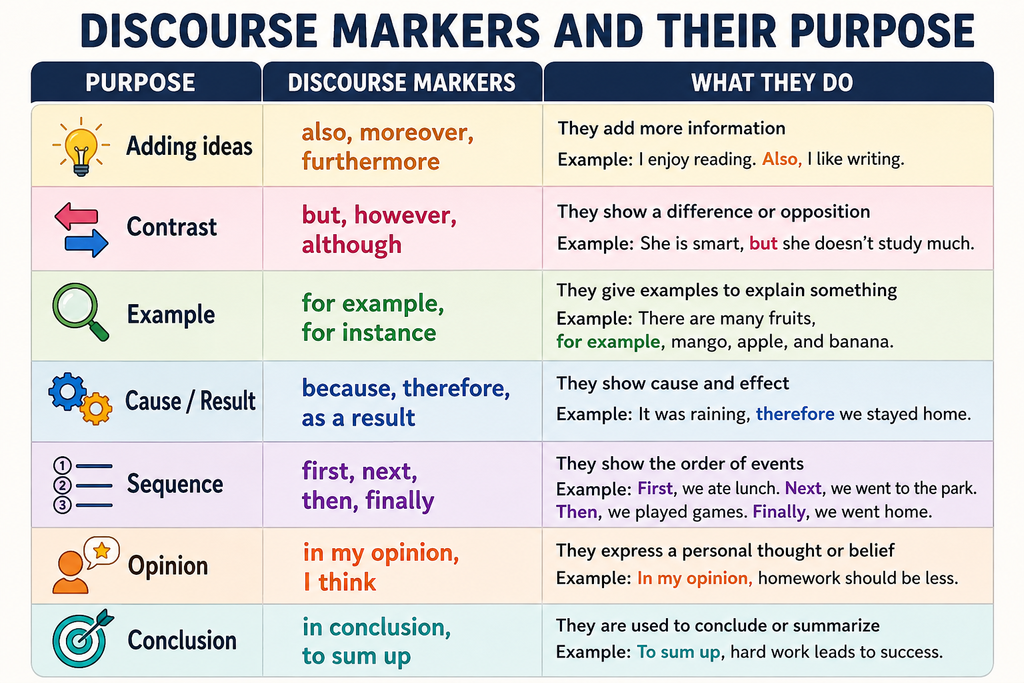
Discourse Markers: A Useful Table
A Simple Classroom Activity
Try this activity with your classmates or friends.
Complete the sentences using suitable discourse markers:
1. I wanted to play cricket. __________, I had to complete my homework.
2. __________, we visited the museum. Then, we went to the park.
3. He worked hard. __________, he achieved success.
4. Many students enjoy outdoor games. __________, they like cricket and football.
5. __________, we should use our time wisely.
Possible Answers:1. However2. First3. Therefore4. For example5. In conclusion
Remember that more than one answer may sometimes be possible, depending on the meaning.—
Tips for Students-
Learn discourse markers according to their functions, not just as separate words.
Use them naturally; do not put one in every sentence.
Listen carefully to speeches, interviews, and English videos to notice how speakers connect their ideas.
Use discourse markers while writing essays, letters, stories, and speeches.-
Practise speaking for one minute on a topic using words like first, however, for example, therefore, and finally.—
Final Thought
Discourse markers may be small words and phrases, but they make a big difference to communication. They help your ideas flow smoothly and make your English easier to understand.So, the next time you speak or write in English, do not simply put ideas together. Connect them meaningfully!
First, think clearly. Then, organise your ideas. Finally, use the right discourse markers and communicate with confidence.
Good English is not only about knowing words—it is also about knowing how to connect ideas.