Common English Writing Mistakes and Simple Ways to Avoid Them
Writing English correctly is not only about knowing grammar rules. It is also about developing the habit of noticing and correcting our own mistakes.Many students can understand English well and speak with confidence, yet they make small mistakes while writing. These mistakes may occur because they write too quickly, forget basic rules, or do not check their work after writing.The good news is that most common writing mistakes can be reduced through regular practice and a simple self-checking routine.
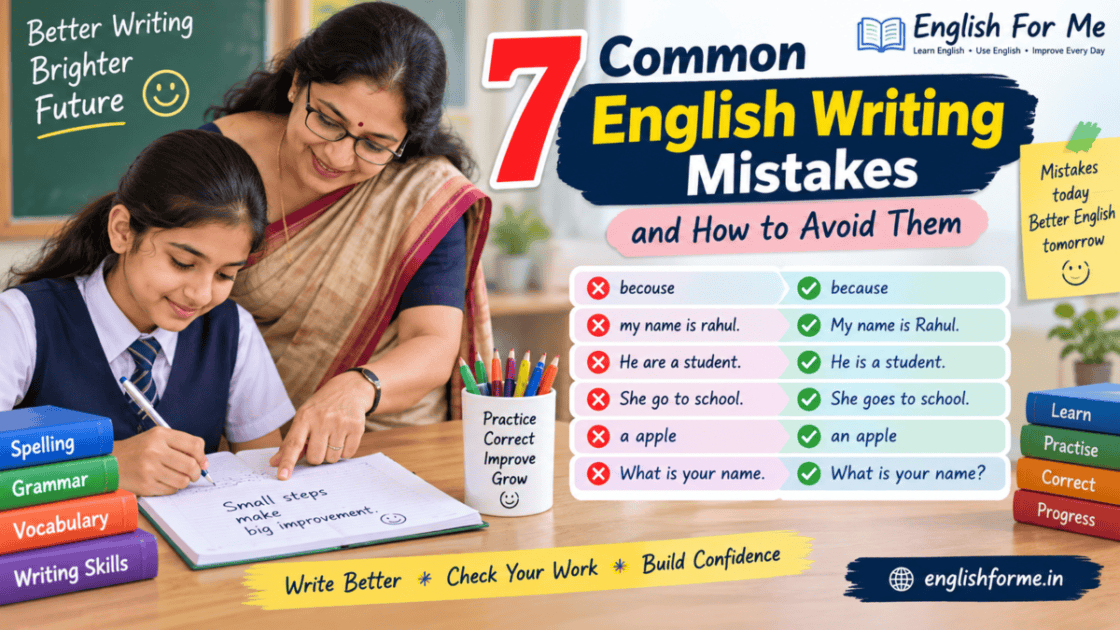
1. Spelling Mistakes
Spelling is one of the most common problems in English writing.
Students may write:
– becouse instead of because
– recieve instead of receive
– seperate instead of separate
– goverment instead of government
– enviroment instead of environment
How to improve spelling
Use the Look–Cover–Write–Check method:
1. Look at the correct spelling.
2. Cover the word.
3. Write the word from memory.
4. Check it.
5. Repeat the process for difficult words.
Students can also maintain a “My Difficult Words” notebook. Whenever they make a spelling mistake, they should write the correct word and use it in a sentence.
For example:Environment
We must protect our environment.
Regular practice makes correct spelling automatic.
2. Incorrect Use of Capital Letters
Capital letters are often ignored by students, especially when they are writing quickly.
Remember:Use a capital letter:- at the beginning of a sentence- for names of people- for names of places- for countries and states- for days and months- for the pronoun
IExamples
❌ my name is rahul.
✅ My name is Rahul.
❌ i live in nagpur.
✅ I live in Nagpur.
❌ we visited maharashtra in june.
✅ We visited Maharashtra in June.
A useful checking question
After writing, ask:«“Have I used a capital letter wherever it is necessary?”
3. Improper Use of “To Be” Verbs
Another common problem is the incorrect use of:am, is, are, was, were
Students should remember the following pattern:
| Subject | Present | Past |
| I | am | was |
| He/She/It | is | was |
| We | are | were |
| They | are | were |
Examples
❌ He are a student.✅ He is a student.
❌ They is happy.✅ They are happy.
❌ I is ready.✅ I am ready.
❌ We was late.✅ We were late.
4. Subject–Verb Agreement
The subject and verb must agree with each other.Students often write:
❌ He play cricket.✅ He plays cricket.
❌ She go to school every day.✅ She goes to school every day.But:
❌ They plays cricket.✅ They play cricket.
She writes well.- He plays football.- They write well.- We play football.
5. Missing Articles: A, An and The
Articles are small words, but they are very important.
Examples❌ He is good boy.✅ He is a good boy.
❌ She ate apple.✅ She ate an apple.
❌ Sun rises in east.✅ The sun rises in the east.
Students should develop the habit of checking whether a singular countable noun requires a, an or the.
6. Confusing Similar Words
Some English words look or sound similar but have different meanings.
| Words | Meaning |
| your / you’re | your = belonging; you’re = you are |
| their / there | their = belonging; there = place |
| its / it’s | its = belonging; it’s = it is |
| than / then | than = comparison; then = time order |
| to / too/two | to = direction; too = also/excessively; two = number |
Students should learn these words through sentences, not merely by memorising their meanings.
For example:You’re a good student.This is your book.
7. Punctuation Mistakes
Correct punctuation makes writing clear and meaningful.Students should know the basic punctuation marks:-
. Full stop-
? Question mark-
! Exclamation mark-
, Comma
Examples❌ What is your name.✅ What is your name**?**
❌ What a beautiful flower it is.✅ What a beautiful flower it is**!**
❌ Rahul Priya and Amit went to school.✅ Rahul, Priya and Amit went to school.
The S–C–T–V–P Self-Check Method
One of the best ways to improve writing is to teach students to check their own work. After completing a writing task, ask them to check these five things:
S — Spelling Have I made any spelling mistakes?
C — Capital Letters Have I used capital letters correctly?
T — To Be Have I used am/is/are/was/were correctly?
V — Verb Does the verb agree with the subject?
P — Punctuation Have I used punctuation marks correctly?
Remember: S – C – T – V – P This five-point checklist can be used for paragraphs, letters, essays, reports, dialogues, messages and examination answers.
Try an “Error Hunt” Activity
Instead of only explaining grammar rules, give students an incorrect paragraph and ask them to become English Detectives.Find and correct the mistakes:
«my friend rahul are a good student. he go to school everyday. he have a english book. yesterday he was absent from school.»
Correct version:«My friend Rahul is a good student. He goes to school every day. He has an English book. Yesterday, he was absent from school.»
Students can identify:- capital letter mistakes- is/are mistakes- subject–verb agreement- go/goes- have/has- article usage- spelling- punctuationThis activity makes grammar active and practical.
From “Teacher Correction” to “Self-Correction”
A student who always depends on the teacher to find mistakes may continue making the same mistakes.Our objective should be:
Teacher tells → Student understands → Student practises → Student notices → Student corrects → Student improves
The ultimate goal is self-correction.Before submitting any piece of writing, students should develop the habit:
WRITE → STOP → CHECK → CORRECT → SUBMIT
Even spending two minutes on checking can make a significant difference.
Final Message for Students
Do not be afraid of mistakes.A mistake is not the end of learning; it is an opportunity to learn something correctly.Write every day.Read every day.Notice your mistakes.Correct them.Use the correct form again.Good writing is not produced by avoiding mistakes completely. It is developed by recognising, correcting and learning from mistakes.Start today with one simple habit:
«“Before I submit my English writing, I will always check it.”»That small habit can lead to a big improvement in your English writing.
English For Me — Learn English. Use English. Improve Every Day.