English Is Not a Subject, It Is a Language: Focus on Developing Linguistic SkillsMeta Title: English Is Not a Subject, It Is a Language | Develop Linguistic SkillsMeta Description: Discover why English should be learned as a language, not just a school subject. Learn how listening, speaking, reading, and writing skills can help students become confident communicators.Focus Keyword: English is not a subject, it is a languageSecondary Keywords: linguistic skills, English language learning, four language skills, listening speaking reading writing, English communication skills—
English Is Not a Subject, It Is a Language: Focus on Developing Linguistic Skills
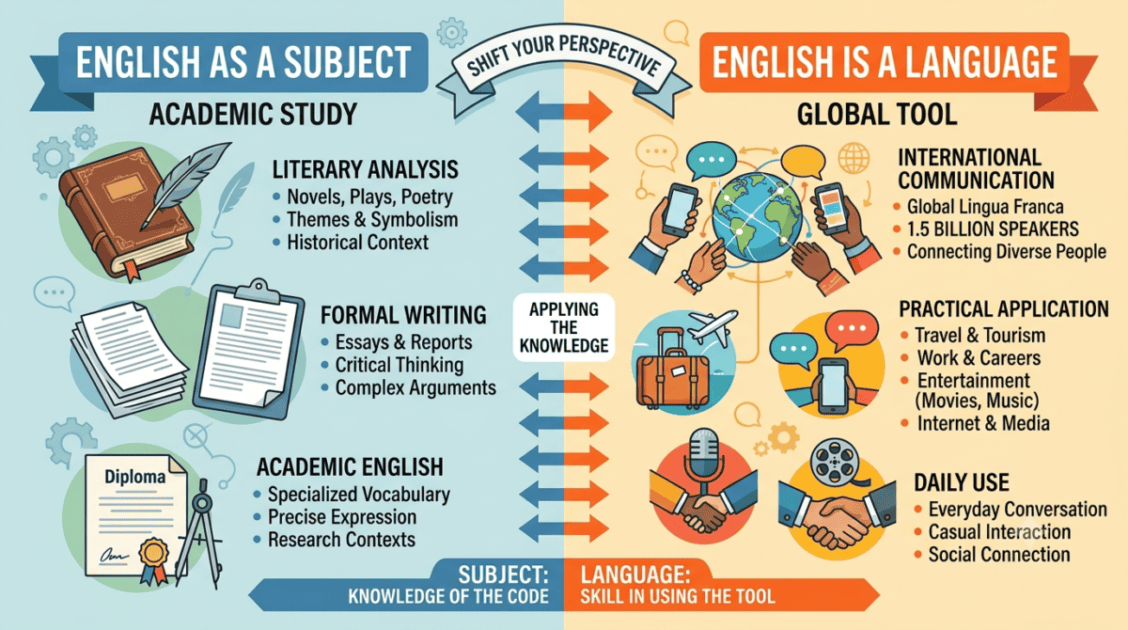
Many students think of English as just another school subject. They study it to pass examinations, complete homework, and score good marks. Once the examination is over, the textbook is kept aside until the next academic year. This examination-oriented approach prevents learners from acquiring real language proficiency.English is not merely a subject; it is a language that should be used every day. Like any other language, English is learned through regular exposure, meaningful communication, and continuous practice. The goal should not be to memorise grammar rules but to develop the ability to understand, speak, read, and write confidently.
Why English Should Be Learned as a Language
Imagine learning to swim by reading a book without entering the water. It is impossible. Similarly, learning English only through textbooks without using it in real life cannot make anyone fluent.Children learn their mother tongue naturally. They first listen, then speak, later learn to read, and finally write. English should also be learned in the same sequence. Language develops through communication, not through memorisation alone.
The Four Essential Linguistic Skills
True language learning depends on mastering four interconnected skills.
1. Listening Skills
Listening is the foundation of language learning. Students should listen to English stories, conversations, speeches, podcasts, news, and educational videos.Benefits of listening:- Improves pronunciation- Builds vocabulary naturally- Develops comprehension- Familiarises learners with sentence patterns- Increases confidence in communication
Daily Tip: Spend at least 15 minutes listening to English every day.
2. Speaking Skills
Speaking transforms knowledge into communication. Many students hesitate because they fear making mistakes. However, mistakes are stepping stones to fluency.
Ways to improve speaking:-
Speak English with classmates and friends.
– Describe your daily routine in English.
– Participate in classroom discussions.
– Record yourself speaking.
– Think in English instead of translating.
Remember:Fluency comes from practice, not perfection.
3. Reading Skills
Reading is one of the fastest ways to improve language. Every page introduces new vocabulary, expressions, and sentence structures.Students can read:- Newspapers- Short stories- Novels- Blogs- Biographies- Articles- School textbooks
Benefits include:-
Better vocabulary-
Improved grammar-
Enhanced comprehension-
Broader knowledge-
Better writing skills
Read every day—even if it is just one page.
4. Writing Skills
Writing helps organise thoughts logically and express ideas clearly.Students should practise:- Diary writing- Paragraph writing- Emails- Reports- Essays- Summaries- Notices- Blog writing
Writing regularly improves grammar, vocabulary, creativity, and confidence.
Grammar Is Important—but It Is Not Everything
Grammar is like the skeleton of a language. It provides structure, but language becomes meaningful only when used in communication.Instead of memorising rules alone, students should use grammar while:- Speaking- Writing- Reading- Listening
Grammar supports communication—it should never replace communication.
Create an English Learning Environment
Learning becomes easier when English becomes a part of everyday life.
Students should:-
1. Speak English in school whenever possible.-
Learn five new words every day.-
Watch English educational videos.-
Listen to English songs and podcasts.
– Read English newspapers.-
Maintain a vocabulary notebook.-
Write a daily journal.-
Use English while interacting with teachers and friends.
Small daily habits produce remarkable results over time.—
The Teacher’s Role
Teachers play a vital role in creating an English-rich classroom. Instead of focusing only on textbook exercises, they should encourage active language use through:-
Pair work-
Group discussions-
Role plays-
Storytelling-
Debates-
Presentations-
Language games-
Project-based learning
A classroom where students speak English without fear becomes a place where real learning happens.—The Student’s Responsibility
No language can be learned overnight. Success comes through consistency.
Students should remember:-
Listen every day.-
Speak every day.-
Read every day.-
Write every day.
Even 20–30 minutes of daily practice can lead to significant improvement within a few months.
English Is a Skill for Life
English is the language of:-
Higher education-
Science and technology-
Business-
Tourism-
Research-
International communication-
Digital learning
Strong communication skills open doors to better education, successful careers, and global opportunities.Learning English is not only about securing good marks—it is about preparing for life.
- English should never remain confined to classrooms and examinations. It is a living language that grows through use. Students who develop the four linguistic skills—Listening, Speaking, Reading, and Writing (LSRW)—become confident communicators, lifelong learners, and successful professionals.Do not study English only to pass an examination.Use English to express your ideas, share your thoughts, connect with people, and explore the world.
- «”Marks may help you pass an examination, but linguistic skills help you succeed in life. Learn English not merely as a subject but as a language.”»