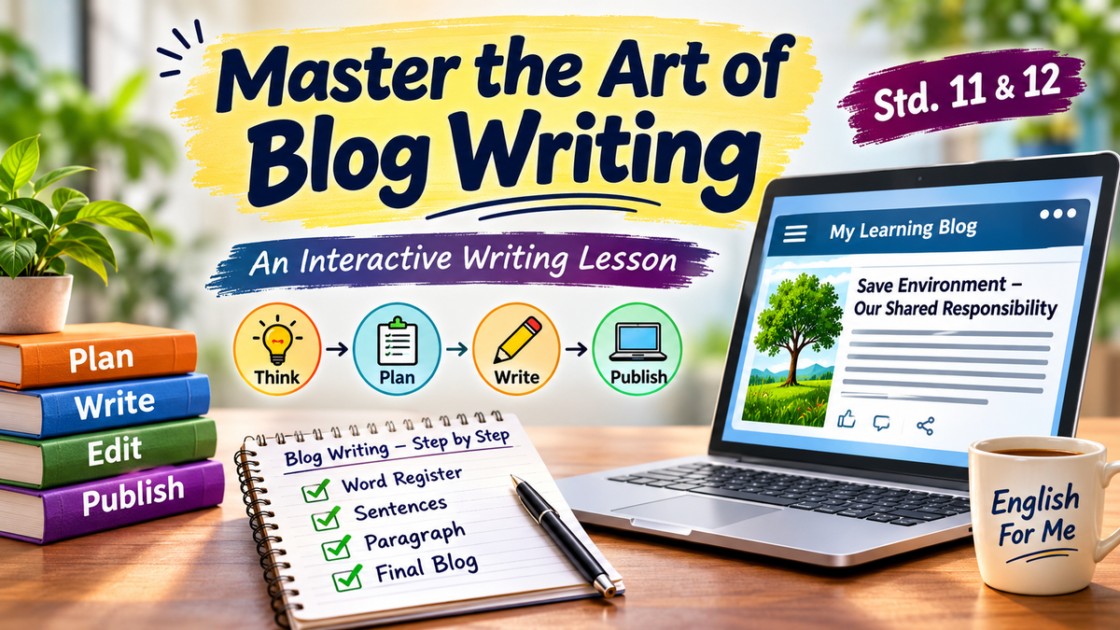
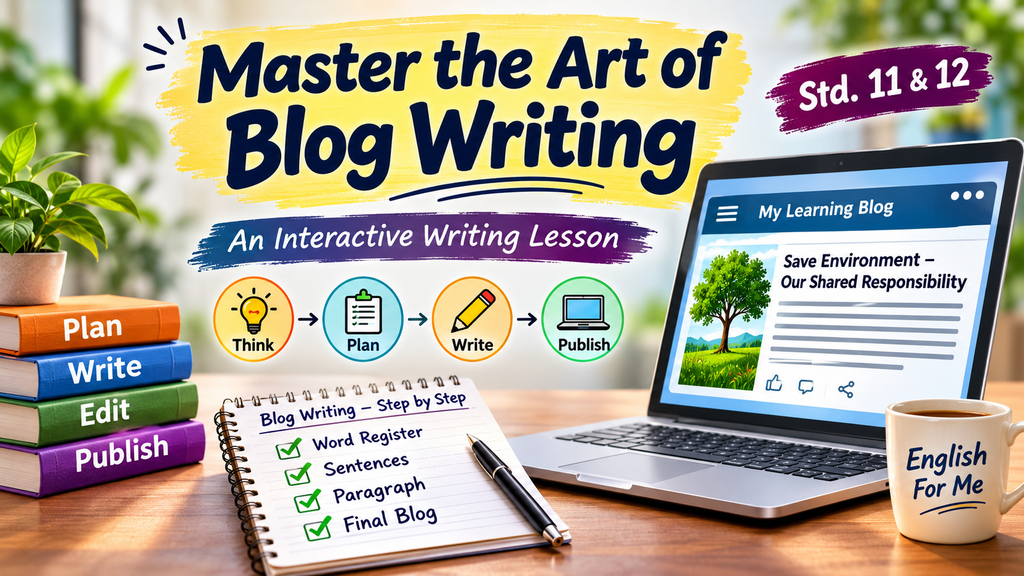
MASTER THE ART OF BLOG WRITING
Think • Plan • Organise • Write • Publish
Interactive Writing Workshop | Std. 11 & 12
English For Me | Prafulla Mahure1. What is Blog Writing?
A blog is an online journal or informational webpage where a writer shares ideas, experiences, opinions, information or suggestions on a particular topic.
A good blog is informative, interesting, reader-friendly and written in a conversational style.
2. Understand the Blog Writing Format
A typical school-level blog presentation may include the following elements:
2. Blog title: Name of the blog
3. Date: Date of publication
4. Headline: Attractive title of the post
5. Blog content: Introduction, main discussion and conclusion
6. Social profile: Links or names of social platforms
In examination answers, follow the format and word limit prescribed by your teacher or question paper.
3. Learn the Four-Step Writing Technique
Do not start writing the final blog immediately. Develop your ideas step by step.
STEP 1 – Prepare a Word Register
Topic: Save Environment
Click on the words to add them to your word register below.
STEP 2 – Make Meaningful Sentences
Use the words to frame complete sentences.
1. Trees provide us with oxygen.
2. Plastic pollution threatens marine life.
3. We must conserve water and electricity.
4. Every citizen has a responsibility to protect nature.
STEP 3 – Develop a Paragraph
Connect your sentences logically. Use linking words such as:
STEP 4 – Write Your Final Blog
Give your blog an attractive headline and organise your ideas into paragraphs.
Introduction → Main discussion → Examples and suggestions → Conclusion
4. Explore Important Writing Skills
Introduce the topic and attract the reader’s attention.
Example: The environment is our most precious resource. Unfortunately, human activities are causing serious environmental problems.
Explain the topic, causes, effects, benefits or problems. Support your points with examples.
Offer practical ideas using expressions such as:
- We should…
- It is our responsibility to…
- Everyone must take an initiative to…
- We can make a difference by…
End with a strong message or appeal.
Example: Let us join hands to protect our planet. A greener tomorrow begins with our actions today.
5. Test Your Understanding
Choose the correct answer for each question.
Q1. What should you do before writing a blog?
Q2. What is a word register?
Q3. Which expression is suitable for suggesting a solution?
Q4. Which is the best way to conclude a blog?
Q5. What makes a blog reader-friendly?
6. Guided Blog Writing Practice
Select a topic and develop your own blog. Use the prompts to organise your thoughts.
Suggested practice target: approximately 100–150 words. Follow the word limit given in your examination.
7. Your Final Blog – Preview
Check your writing below. Make corrections before printing.
My Learning Blog
Your Blog Headline
Your introduction will appear here.
Your main discussion will appear here.
Your conclusion will appear here.
Only the final blog preview will be printed.
8. Independent Writing Challenge
Now try writing a blog without copying a model answer.
Hints: Communication • Education • Career • Confidence • Global opportunities
Hints: Punctuality • Discipline • Planning • Success • Avoiding waste
Hints: Education • Innovation • Social responsibility • Leadership • National development
- Have I written an attractive headline?
- Is my introduction interesting?
- Have I developed relevant ideas?
- Have I used suitable linking words?
- Are my sentences grammatically correct?
- Have I concluded with a meaningful message?
Think Independently. Write Confidently.
Good writing is not memorising words. It is organising your thoughts and expressing them clearly.
English For Me – Learn English Togetherenglishforme.in