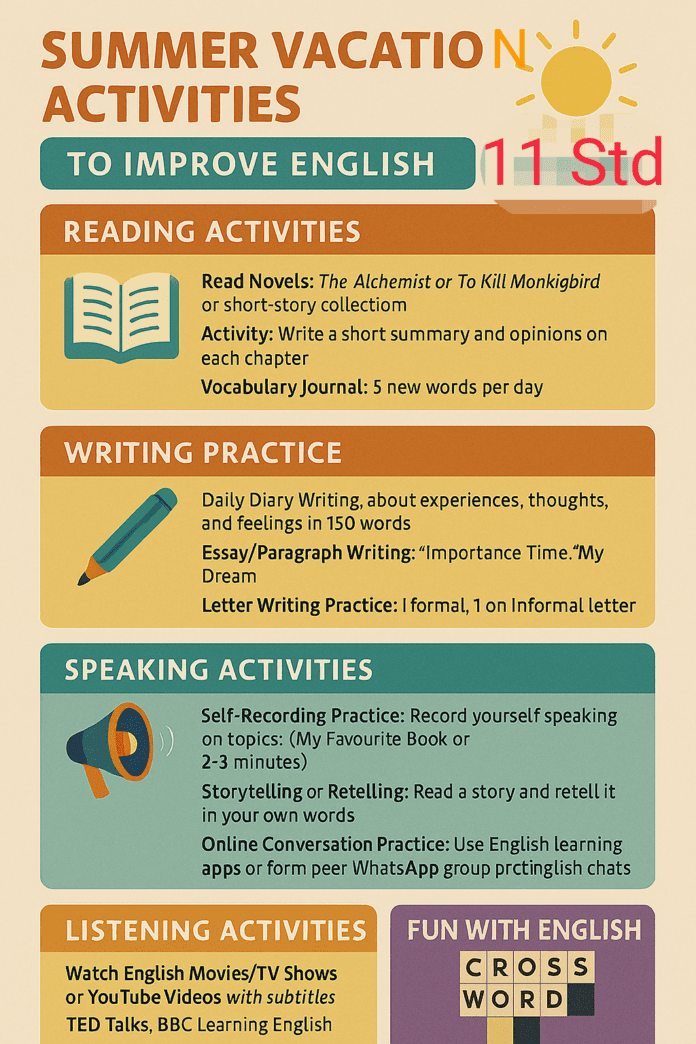
Here are Summer Vacation Activities specially designed for 11th Standard students to help them improve their English skills in a fun and engaging way:
1. Reading Activities
Read a Novel or Short Story Collection Suggested titles:The Alchemist, To Kill a Mockingbird, Animal Farm, or short stories by Ruskin Bond. Activity: Write a short summary and your opinion about each chapter.
Daily Newspaper Reading Focus on editorials, headlines, and feature articles. Activity: Maintain a Vocabulary Journal with 5 new words per day.
2. Writing Practice
Daily Diary Writing Write about daily experiences, thoughts, and feelings in 150 words.
Essay/Paragraph Writing (2 per week) Suggested topics: “Importance of Time”, “My Dream Career”, “Role of Social Media”, etc.
Letter Writing Practice Write one formal and one informal letter every week.
3. Speaking Activities
Self-Recording Practice Students can record themselves speaking on various topics (2–3 mins). Topics: My Favourite Book, A Memorable Day, My Role Model, etc.
Storytelling or Retelling Read a story and retell it in your own words.
Online Conversation Practice Use English learning apps or form peer WhatsApp groups to practice English chats and voice notes.
4. Listening Activities
Watch English Movies/TV Shows/YouTube Videos (with subtitles) Suggestions: TED Talks, BBC Learning English, motivational speeches.
Listen to English Songs/Podcasts Write the lyrics or summary of the audio.
5. Fun with English
Word Games Play Scrabble, Crossword puzzles, or Word Search.
English Through Drama Practice enacting short English plays or dialogues with friends or family.
Quiz Yourself Create or participate in weekly online English quizzes.
Here are the paraphrases and summaries of all the poems of Std 10 English as first language:
1. “All the World’s a Stage” – William Shakespeare
Paraphrase:
Life is like a stage, and every person is an actor playing different roles. From birth to old age, people go through seven stages: infancy, childhood, youth, adulthood, middle age, old age, and finally, death. Each stage has its own unique characteristics, emotions, and responsibilities. Eventually, we grow weak, lose our abilities, and fade away from life.
Summary:
This poem, taken from Shakespeare’s As You Like It, presents a philosophical perspective on human life. It describes the seven stages of life, showing how people transition from one role to another. The poem emphasizes that life is temporary and follows a natural cycle, just like a play where actors enter and exit the stage.
2. “Where the Mind is Without Fear” – Rabindranath Tagore
Paraphrase:
The poet prays for a world where people live fearlessly and with dignity. He envisions a society where knowledge is freely accessible, and people are not divided by narrow-minded prejudices. Truthfulness, hard work, and reason should guide human actions, leading to progress. He asks God to help his country move toward enlightenment and freedom.
Summary:
Tagore’s poem is a prayer for a free and progressive nation. It expresses his dream of an ideal society where people are courageous, united, and guided by reason and honesty. He emphasizes the importance of breaking away from ignorance and oppression to achieve true freedom.
3. “I Think I Could Turn and Live with Animals” – Walt Whitman
Paraphrase:
The poet admires animals for their simplicity, honesty, and contentment. Unlike humans, they do not complain, regret, or obsess over material possessions. They do not engage in religious rituals or worry about social status. Animals live peacefully and naturally, which makes the poet feel connected to them. He wonders if humans once possessed these qualities but lost them over time.
Summary:
This poem contrasts animals with humans, highlighting the purity and simplicity of animal life. Whitman suggests that humans have complicated their lives with greed, religion, and social structures, losing their natural happiness. The poem encourages self-reflection on what truly brings peace and fulfillment.
4. “The Pulley” – George Herbert
Paraphrase:
When God created humans, He gave them various blessings like strength, wisdom, beauty, and honor. However, He withheld the gift of rest, ensuring that humans would always feel a sense of longing. This restlessness would lead them to seek God, as they would never be fully satisfied with material wealth alone.
Summary:
Herbert’s poem presents a religious perspective on human nature. It suggests that human dissatisfaction is part of God’s plan, as it keeps people connected to spirituality. The pulley symbolizes how God draws people toward Him by making them seek something beyond worldly pleasures.
5. “Night of the Scorpion” – Nissim Ezekiel
Paraphrase:
The poet recalls a night when his mother was stung by a scorpion. Villagers gathered and chanted prayers, believing her suffering would cleanse her of past sins. They performed various superstitious rituals, while the poet’s rational father tried using medical treatments. Despite all efforts, the pain lasted until the poison eventually wore off. The mother, however, only expressed gratitude that the scorpion had stung her instead of her children.
Summary:
This poem highlights the clash between superstition and rationality. It portrays how rural communities rely on religious beliefs in times of crisis. At the same time, it showcases a mother’s selfless love, as she endures pain without complaint. Ezekiel uses this event to reflect on human emotions and cultural practices.
6. “The Will to Win” – Berton Braley
Paraphrase:
If you truly desire something, you must be willing to work tirelessly for it, sacrificing comfort and overcoming all obstacles. You must chase your dreams with full determination, ignoring hardships like poverty, illness, and fear. If you persist with faith and confidence, with the help of God, you will achieve your goal.
Summary:
This poem is a motivational call to action, emphasizing hard work, persistence, and self-belief. Braley inspires readers to chase their dreams fearlessly, despite difficulties. The poem conveys that success comes to those who are willing to give their all and never give up.
7. “A Thing of Beauty is a Joy Forever” – John Keats
Paraphrase:
Beautiful things bring everlasting joy and comfort. They provide a peaceful escape from life’s struggles, acting as a source of inspiration. Beauty can be found in nature, art, and human experiences, making life more meaningful. It never fades away but continues to nourish the soul.
Summary:
Keats’ poem expresses the Romantic belief that beauty is eternal and essential for human happiness. It highlights how beautiful things, whether natural or artistic, have the power to uplift the spirit. Keats celebrates the deep emotional and spiritual connection between humans and beauty.
8. “The Height of the Ridiculous” – Oliver Wendell Holmes
Paraphrase:
The poet writes something he finds extremely funny and expects others to laugh as well. However, when he shares it, the reaction is much stronger than he imagined—his readers laugh uncontrollably to the point of physical pain. The exaggerated response amuses the poet, showing the unexpected power of humor.
Summary:
This poem humorously explores the effects of exaggerated emotions. Holmes plays with the idea that laughter can be overwhelming and even dangerous. Using hyperbole, he creates a lighthearted and entertaining reflection on the power of humor in literature.
These paraphrases and summaries break down each poem’s message in a simple, clear way.
Poetic Appreciation of “A Thing of Beauty is a Joy Forever”
“A Thing of Beauty is a Joy Forever” is an excerpt from John Keats’ long poem Endymion. In this poem, Keats celebrates the everlasting beauty of nature and its power to provide joy, comfort, and inspiration.
Rhyme Scheme: The poem follows the rhyming couplet (AABB) pattern, creating a harmonious and musical flow that enhances its lyrical quality.
Figures of Speech:
Metaphor – “A bower quiet for us” compares beauty to a peaceful shelter.
Personification – “Some shape of beauty moves away the pall” gives beauty a living, active role.
Alliteration – “Some shape of beauty” (repetition of the ‘s’ sound).
Imagery – The poet creates vivid pictures of beautiful elements in nature, such as the sun, moon, trees, and flowers.
Central Idea/Theme: The poem conveys the idea that beauty, whether found in nature, art, or human experiences, has a timeless and everlasting impact on the human soul. Keats emphasizes that beauty brings joy, removes sorrow, and provides comfort, making life more meaningful. His Romantic vision celebrates the deep emotional and spiritual connection between humans and the beautiful things around them, reinforcing the idea that true beauty is eternal.
Poetic Appreciation of “The Height of the Ridiculous”
“The Height of the Ridiculous” by Oliver Wendell Holmes is a humorous poem that highlights the impact of excessive laughter and exaggeration. The poet narrates how his own writing, intended to be amusing, ends up causing extreme reactions in those who read it.
Rhyme Scheme: The poem follows a rhyming couplet (AABB) pattern, giving it a rhythmic and playful tone.
Figures of Speech:
Hyperbole – The poet exaggerates the reaction of the readers, as they laugh uncontrollably to the point of physical pain.
Alliteration – “Ten days and nights with sleepless eye” (repetition of the ‘s’ sound).
Imagery – The poet vividly describes the readers’ extreme reactions, making the scene more dramatic and amusing.
Personification – The poet suggests that his words have the power to physically affect people.
Central Idea/Theme: The poem humorously explores the power of laughter and the impact of exaggerated expressions. It shows how humor can be infectious and overwhelming, sometimes to an unintended extent. Holmes uses wit and hyperbole to entertain the reader while emphasizing the joy and uncontrollable nature of amusement. The poem ultimately celebrates the lighthearted and whimsical aspects of life.
“Unstoppable Spirit: The Power of Determination and Endurance”
Introduction: Poetry has the ability to inspire, uplift, and ignite a fire within us. “Night of the Scorpion” by Nissim Ezekiel and “The Will to Win” by Berton Braley may seem vastly different in their themes, but both capture the essence of human resilience. One explores a mother’s quiet strength in the face of suffering, while the other celebrates the relentless pursuit of success. Through vivid imagery and powerful emotions, these poems remind us of the willpower that drives human beings to endure, fight, and overcome life’s challenges. Let’s dive into the poetic appreciation of these masterpieces!
Poetic Appreciation of “Night of the Scorpion”
“Night of the Scorpion” is a poignant poem by Nissim Ezekiel that vividly recounts a childhood memory of the poet’s mother being stung by a scorpion. Through this personal experience, Ezekiel explores themes of superstition, suffering, and maternal love.
Rhyme Scheme: The poem is written in free verse, meaning it does not follow a specific rhyme scheme. This allows the narrative to flow naturally, enhancing its storytelling quality.
Figures of Speech:
Metaphor – “Flash of diabolic tail” compares the scorpion to an evil force.
Simile – “The peasants came like swarms of flies” compares the villagers to flies, emphasizing their frantic response.
Alliteration – “Parting with his poison” (repetition of the ‘p’ sound).
Imagery – The poet creates vivid mental pictures, such as the shadows of scorpions cast on mud walls by lanterns.
Central Idea/Theme: The poem highlights the contrast between superstition and rationality, as villagers respond to the scorpion bite with prayers and rituals, while the poet observes with curiosity. It also portrays the deep selflessness of a mother, as she endures pain without complaint. Through this incident, Ezekiel subtly critiques blind faith and emphasizes the resilience of human emotions, particularly a mother’s enduring love and sacrifice.
Poetic Appreciation of “The Will to Win”
“The Will to Win” by Berton Braley is an inspirational poem that emphasizes the power of determination, perseverance, and unwavering commitment to achieving one’s goals. It serves as a motivational call to action, urging individuals to give their best effort in pursuit of success.
Rhyme Scheme: The poem follows a rhythmic and flowing structure, with a free verse-like pattern, though it maintains a sense of rhyme and repetition that enhances its motivational tone.
Figures of Speech:
Repetition – The phrase “If you…” is repeated to reinforce the poem’s message of relentless pursuit.
Alliteration – “Sweat for, fret for” (repetition of the ‘f’ sound).
Metaphor – “Besiege and beset it” compares determination to a battle or siege.
Imagery – The poem paints vivid pictures of struggle and endurance, such as “cold or poverty, famished or gaunt.”
Central Idea/Theme: The poem conveys the idea that success is achieved only through unwavering dedication, hard work, and an indomitable spirit. It encourages individuals to pursue their dreams fearlessly, regardless of obstacles, and to maintain faith in their abilities and in divine support. Braley’s message is clear: if one truly desires something and is willing to sacrifice for it, success is inevitable.