Home Blog Page 38

Types of Verbs in English : 8 Modal Auxiliaries, Primary, Main

3
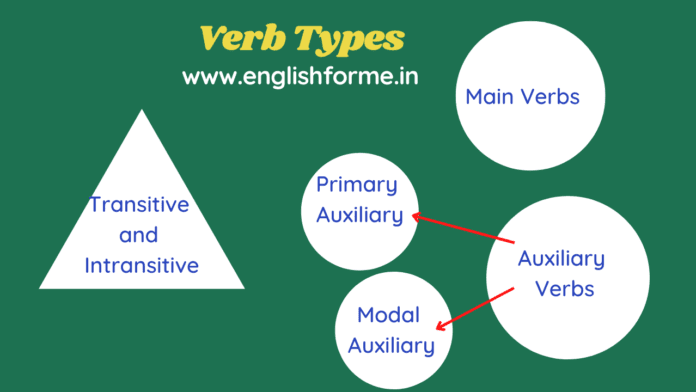
Verb Types

Verb Types

A verb used in forming the tenses, moods, and voices of other verbs is auxiliary verb.


The primary auxiliary verbs in English are be, do, and have. (am, is, are,was, were, do, does, did, have, has, had)


Sometimes primary auxiliary verbs perform the function of main verbs when they stand alone in the sentence.


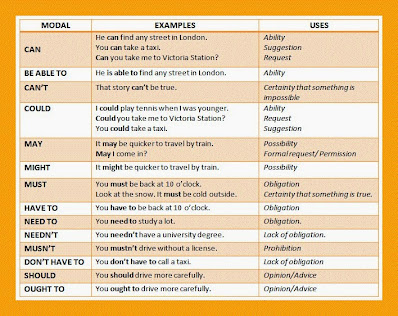
The modal auxiliaries are can, could, may, might, must, shall, should, will, and would.

The main verb is also called the lexical verb or the principal verb. The Main verb typically shows the action or state of being of the subject. Main verbs can stand alone, or they can be used with a helping verb, also called an auxiliary verb.

Go through the sentences given below and say whether the underlined verbs are main verbs or primary auxiliary verbs or modal auxiliary verbs.

1.I had a very simple upbringing.
2.I was immensely impressed.
3.I had learnt from my childhood that money did not mean everything in life.
4.He was a convent educated boy.
5.They did all the work in time.
6.I had to achieve a lot in life.
7. I was very thirsty.
8. I had carried with me.
9. We were lucky.
10. I was wearing a red scarf.
11. We had suggested hara-kiri.
12. We were overjoyed to see tiny green leaves.
13. How long shall we continue to live this life of contradiction ?
14. We must remove this contradiction at the earliest possible moment.
15. I don’t know.
16. I can hear voices.
17. You would better go back.
18. Mrs Adis was sitting in the old basket armchair by the fire.
19. ‘D’ company was successful in occupying the eastern portion of Area Collar.
20. The Defense Minister was on his way to Amritsar.

Grammar Tenses

Frame your own ten sentences using these verbs and say their types.

Grammar Tenses: Types of Verbs in English : 8 Modal Auxiliaries, Primary, Main

Verb Types – Transitive  and Intransitive Verbs

Transitive verbs have objects. Intransitive verbs have no objects .

She is fetching water. (Present continuous tense)

In this sentence verb ‘fetching’ has object ‘water’. So the verb ‘fetching’ is transitive verb. 

Farmers grow (🍅 🍅) tomatoes in the field.

In this sentence verb ‘grow’ has object ‘tomatoes’. So the verb ‘grow’ is transitive verb.

Tomatoes grow in the field.

In this sentence verb ‘grow’ has no object because action does not pass on. So the verb ‘grow’ here is intransitive verb. 

Some verbs are transitive and Intransitive depending upon the function in the sentence. 

Indicate whether the Verbs in the following sentences are Transitive or Intransitive. Name the Object of each Transitive Verb’ and the Complement of each Verb of Incomplete Prediction.

In the following sentences the verbs in bold types are intransitive , word or group of words in red colour are complements. The underlined verbs are transitive and the words in blue colour are objects.

  1. The boy stood on the burning deck. Intransitive
  2. Tony has fallen sick. Intransitive
  3. The water is very cold.
  4. The man saw the accident with his own eyes. Transitive The man saw what? The answer is accident.So object of ‘saw’ is ‘accident’
  5. The baby fell asleep.
  6. They are French.
  7. The rumour seems true.
  8. He did not tell the truth.
  9. They made her queen.
  10. The bad boys hide their faults.
  11. He is hiding behind the tree.
  12. We patiently waited at the station.
  13. The bird flew down and took away the cheese.
  14. Our children like sweets.

Do it yourself. 

Verb Types – Transitive  and Intransitive Verbs

  1. The peon rang the bell.
  2. The bell rang after the first period.
  3. Sam sang a beautiful song.
  4. They sang well in the function.
  5. Who has broken the window?
  6. The windows broke in the storm.
  7. She called her servant a fool.
  8. His parents named her Patricia.
  9. He painted the box red.
  10. You look sad.
  11. The milk turned sour.
Types of Verbs in English : 8 Modal Auxiliaries, Primary, Main


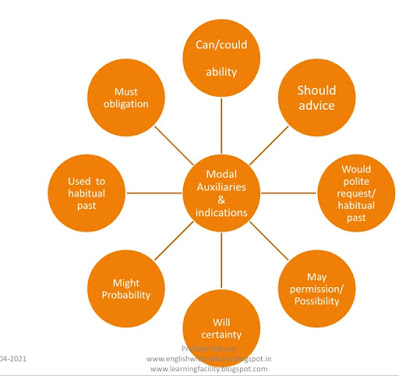
Read the following sentences and observe the use of modal auxiliary .
     

1.     May I speak to you for a moment?                      ‘May’ indicate permission    

2.     She can speak fluent German.                             ‘can’     —        ability     

3.     He might get angry at first, but hopefully he will understand your situation.                                                                             ‘might’- probability     

4.     You should try doing more exercise regularly.         ‘should’ – advice     

5.     Now recruits shall report to the sergeant at 9 am.     Shall—certainty     

6.     I must go home now. It’s late.                                   Must- obligation  

7.     Could you put this book on the shelf, please?        Could – polite request                

क्रीयापदाला सहाय्य करणार्‍या क्रियापदांना सह्याकारि क्रियापदे म्ह्णतात.


    be, am, is, are, was, were, do, does, did, have, has, had, shall, will, should, would, can, could, may, might, must, etc.
    उपयोग.


1. am, is, are यांचा उपयोग Present Continuous Tense मध्ये व Simple Present Tense च्या Passive Voice मध्ये करतात.
2. was, were यांचा उपयोग Past Continuous Tense मध्ये व Simple Past Tense च्या Passive Voice मध्ये करतात.
3. do,does, did यांचा उपयोग प्रश्नार्थक व नकारात्मक वाक्यामध्ये करतात.
4. shall, will यांचा उपयोग Future Tense मध्ये करतात.
5. should यांचा उपयोग उपदेश/ सल्ला देण्यासाठी करतात.
6. would यांचा उपयोग भुतकालीन सवय, भुतकाळात वारवांर घडलेली क्रीया दर्शविण्यासाठी ,तसेच shall/will चा भुतकाळ म्ह्णुन वापरतात.
7. can, could क्षमता(ability) व्यक्त करण्यासाठी
8. may परवानगी(Permission), शक्यता(Possibility) व्यक्त करण्यासाठी.
9. might संभाव्यता(Probability)व्यक्त करण्यासाठी.
10. must बंधनकारकता (Obligation, Compulsion)व्यक्त करण्यासाठी.
11. have,has यांचा उपयोग Present Perfect Tense मध्ये करतात.
12. had चा उपयोग Past Perfect Tense मध्ये करतात.
13. be चा उपयोग Future Continuous Tense / Simple Future च्या Passive Voice मध्ये करतात.
14. being चा उपयोग (Present,Past)Continuous Tense च्या Passive Voice मध्ये करतात.
15. been चा उपयोग (Present/Past/Future)  Perfect Tense च्या Passive Voice मध्ये करतात.    

1. Rewrite sentences using proper modal auxiliary.      


ConditionUse of Modal Auxiliaries
a) It is very essential for students to learn calligraphy. Students must learn calligraphy.       
b) It is possible for students to improve their handwriting with practice. Students may improve their handwriting with practice.      
c) My handwriting probably will turn wobbly, if I do not write regularly.  My handwriting might turn wobbly, if I do not write regularly. 
d) Nowadays it is needed to use computer technology in education.Nowadays we have to use computer technology in education. 
e) In future the electronic gizmos are sure to create wonder. In future the electronic gizmos will create wonder. 
f) We better keep ourselves updated in the use of computers.  We should keep ourselves updated in the use of computers.


Types of Verbs in English : 8 Modal Auxiliaries, Primary, Main
Modal Auxiliary
Types of Verbs in English : 8 Modal Auxiliaries, Primary, Main

      Fill in the blanks with appropriate modals according to the situations given in the following sentences. 

  (1) Take an umbrella. It …….rain later.

      (2) People …….walk on the grass. 

      (3) ……I ask you a question? 

      (4) The signal has turned red. You ……..wait.

      (5) I was a sportsperson in my school days. I   ……to play badminton.

      (6) I am going to the library. I ……. find my friend there. 

      (1) Take an umbrella. It may rain later.

      (2) People should walk on the grass. 

      (3) May I ask you a question? 

      (4) The signal has turned red. You must wait.

      (5) I was a sportsperson in my school days. I  would / used to play badminton.

      (6) I am going to the library. I will find my friend there. 

Frame Sentences with Modal Auxiliary

Frame sentences by using modal auxiliary for the following predicate.

wear helmet

complete assignment

reach in time

sit here

rain today as sky is cloudy

break a piece of ice

join the excursion

pass std 11 in 2023

EMAIL Writing : Perfect Format and 3 Examples

18
EMAIL Writing

What is Email Writing?

Electronic mail (email) is one of the most commonly used services on the internet, allowing people to send messages to one or more recipient.

What is Formal Email?

An email writing for business communication or professional use is a formal email. The email written for any government department, school authority, company or any officers are the formal emails. Use of polite and formal words, the reason for writing mail, clarity, proper greeting and closing are some of the features of the formal email writing.

Format for EMAIL Writing

EMAIL Writing : Perfect Format and 3 Examples
Email Writing

How can I write email ?

Include a clear subject line and a proper greeting. Keep your message concise, use professional language, and proofread before sending.

Example/Sample of EMAIL Writing to Principal

Write an email . 

You are the college representative and your Principal has assigned you the task of writing an email to the Divisional Officer , Satpuda Mountain Ranges , Nagpur , seeking permission for the mountaineering expedition to be organized by your college. 

_______________________________________
From: student12@gmail.com
_______________________________________
To: divisionalofficerngp@gmail.com
_______________________________________
CC/BCC: 
_______________________________________
Subject : Regarding permission for the mountaineering

_______________________________________

Respected Sir,

I am Manoj Bhaye a college representative of Mahatma Gandhi College of Science Chandrapur. Our college has planned some outdoor and adventurous activities. Mountaineering is one of them. The principal has assigned me the task of getting permission for it.
 As a college representative, I request you to grant us permission for the mountaineering on the Satpuda Mountain Ranges. A batch of 20 students will be the participants. We have basic knowledge of the mountaineering. The participants are capable of mountaineering. We all meet the requirements for the expedition. We will be abide by the rules and regulations.
Kindly do the necessary and grant us permission for mountaineering expedition.

Thanking you,

Regards 

Manoj Bhaye
Class : Std 11th
Mahatma Gandhi College of Science
Chandrapur (MS)

Attachment : 1. a list of students 2. Their fitness certificates

_______________________________________


Expansion of Idea

EMAIL Writing to Editor

You are Tarun Nasake a resident of 96,Model Basti, Nagpur . Compose an email to  the editor of the Lokmat Times, telling him about the nuisance of loud speaker in your area.

_______________________________________
From: tarunnasake@gmail.com
_______________________________________
To: editorlokmattimes@gmail.com
_______________________________________
CC/BCC: 
_______________________________________
Subject :  Nuisance of Loud Speakers

Sir,

     Kindly publish my letter in your esteem newspaper.

I am the resident of Model Basti, Nagpur  I would like to draw your attention towards the sound pollution in our area. Many students from our area are studying in Std 10, Std 12. Their board exam is scheduled in the next month. They need a peaceful atmosphere for study. But prayers in the nearby temple,   masjid and gurudwara are causing disturbancesd.   Because prayers are done through loud speakers at different times of the day .

     If the prayers are done silently or using headphones by the devotees, there would be no disturbances. Students would get peaceful time for study. Concerning authorities should declare this area as a silent zone during examination period . Kindly do the needful.

Thanking you,

Regards,

Tarun Nasake

Email Writing to a Friend

3 Imagine that your friend really need a confidence building message. Send him/her an email communicating  the same advice.

_______________________________________
From: tarunnasake@gmail.com
_______________________________________
To: ganeshpal73@gmail.com
_______________________________________
CC/BCC: 
_______________________________________

Dear Ganesh,

I am really shocked about your decision of discontinuing the study the reason behind that made me surprised. Failure or low score is not the end. You scored low in H.S.C. and want to discontinue study.
It’s not good to quit when thing go wrong. Stick to your effort, you might succeed next year. Many courses are available after H.S.C. Join one of them. Remember ‘quitter never wins, winner never quits’. Success may be near when it seems  far. Be strong and face the world before you. Trying hard will take you to the desired goal. There are many other things in the life that can be done.
Please do write soon and often. So think over your decision with positive outlook.

Yours lovingly,
Tarun Nasake


Email To Teacher

Write an email to English teacher requesting him to advise on how to improve writing skill and comprehensive skill

_______________________________________
From: pravin@gmail.com
_______________________________________
To: ashasutar123@gmail.com
_______________________________________
CC/BCC: 
_______________________________________


Subject: Request for Guidance on Improving Writing and Comprehension Skills


Respected madam,

I hope this email finds you well. I am writing to seek your valuable advice on improving my writing and comprehension skills. As I aim to enhance my proficiency in these areas, I believe your insights and guidance would be incredibly helpful.

Could you kindly suggest some strategies, resources, or practices that would assist me in developing these skills effectively? I am eager to work on this and would appreciate any recommendations you can provide.

Thank you for your time and support. I look forward to hearing from you.

Warm regards,
Pravin Zed
12 Arts A


_______________________________________

What is CC and BCC in email?

“CC” stands for “carbon copy,” and “BCC” stands for “blind carbon copy.” When you CC someone on an email, they receive a copy of the email, and all recipients can see that they were copied. On the other hand, when you BCC someone, they also receive a copy, but their email address is not visible to other recipients. BCC is useful when you want to protect the privacy of email addresses or keep certain recipients unknown to each other.

Brainstorming on Mrs. Adis – A story about Guilt and Excuse

3
Mrs. Adis

Summary of “Mrs. Adis” by Sheila Kaye-Smith

“Mrs. Adis” is a gripping short story set in the English countryside, exploring themes of morality, forgiveness, and maternal instincts.

The story begins on a stormy night when Peter, a poacher, arrives at Mrs. Adis’s cottage seeking refuge. He is on the run, believing he has shot and killed a policeman during a confrontation in the woods. Mrs. Adis, a widow, reluctantly lets him in, despite feeling uneasy about harboring a fugitive.

As Peter recounts the events of the night, a shocking truth emerges: the man he shot was not a policeman, but Mrs. Adis’s son, whom Peter did not recognize in the dark. Overwhelmed by this revelation, Mrs. Adis experiences a whirlwind of emotions—grief for her son and compassion for Peter, who was once her son’s close friend and is now devastated by his mistake.

Despite her heartbreak, Mrs. Adis does not betray Peter’s presence to the authorities when they come searching for him. She silently grapples with her loss and her choice, driven by a complex mix of maternal forgiveness and pity for Peter’s tragic error.

The story ends on an ambiguous note, leaving readers to reflect on Mrs. Adis’s extraordinary strength and moral dilemma. It highlights the complexities of human emotions and the challenge of navigating personal tragedy in the face of societal expectations.

Activities from the margin of the lesson Mrs. Adis


The writer describes Mrs. Adis as –

  • a small woman
  • Thin woman
  • Brown hard face
  • Hair like wrinkles

Mrs. Adis asks Peter crouch whether he has had a quarrel with the keepers. This shows that

  1.  Peter Crouch is hot temper
  2.  He gets into quarrel easily.
  3.  Mr. Adis knew his nature.

List some characteristics of Mrs. Adis based on this incident.
Faithful , trustworthy, good , helpful , forgetful
Give reason :
Vilder guessed that Crouch has taken refuge at Mrs. Adis’ house because he was a friend of Mrs. Adis’s son Tom. Crouch didn’t know that he had shot Tom dead.

The row took place because the keepers scared Peter Crouch who fired the gun in darkness.

Mrs. Adis unlocked the door because she had forgiven Peter and wanted him to run away safely.

Guess the meaning: ‘wrung’ here means
Find the difference between: shivering and trembling

BRAINSTORMING of Mrs. Adis


(A1) (i) Discuss with your partner and describe the atmosphere in the woods when Peter Crouch was heading towards Mrs. Adis’s House. It was-
(a) a dark moonless night.
(b) a few stars in the sky
(c) windless , silent and clear night
(ii) Peter Crouch didn’t knock before entering Mrs. Adis’s house.
The reason was-
(a) Peter Crouch didn’t want to make noise.
(b) He wanted nobody to hear the noise of knocking
(c) He was in haste.
(iii) Go through the text again and find the reasons that forced Peter to shoot down a person.
(a) The keepers spotted him.
(b) He had fears of being caught.
(c) They were more in numbers.
(iv) Mrs. Adis didn’t hand over Peter Crouch to the keepers because-
(a) He was her son Tom’s friend.
(b) Tom would want her to stay by him.

(A2) The writer has used a phrase ‘Thudding Heart’ which means pounding, or beating of heart. Do you know ‘Thud’ is an onomatopoeic word which means a heavy sound made by an object falling to the ground. Discuss with your partner and make a list of Onomatopoeic words that you find in the text.
(a) crackling
(b) rustling
(c) bark

Activities other than the text 

A1 Choose the correct alternative and rewrite the following statements.
1) Peter/ Mrs. Adis was stooping over the fire.
2) Peter knocked the door/walked straight in the cottage.
3) Peter thought he killed/ shot a man.
4) Mrs. Adis was a woman with a hard/soft face.

Ans : 1. Mrs. Adis was stooping over the fire. 2. Peter walked straight in the cottage. 3. Peter thought he shot a man. 4. Mrs. Adis was a woman with a soft face.


A2. Complete the statement: Peter was in trouble because …………
A3. The kettle boiled over and Mrs Adis mechanically put it at the side of the fire. Find the deeper meaning of this statement.
A4. Imagine a young man comes to you pleading to protect him from police. Write how you will react.
A5. Language Study.
1. He did not knock, but walked straight in. (Rewrite into simple sentence.)
Ans. Without knocking he walked straight in.
2. I shot a man. (Rewrite into passive voice.)
Ans. A man was shot by me.
A6. Vocabulary.


Across.                                                                         
2.  a line in the skin of face                               
3, overcrowded
4. too many to be counted

Down
       1. reluctant to do something

Activity Set A


Que. 1 A) Read the extract and complete the activities given below: (12)
In north-east Sussex a great tongue of land runs into Kent. It is a land of woods – the old hammer tongue of land: a long woods of the Sussex iron industry and among the stretch of land brunching woods gleam the hammerponds. Owing to the thickness of the woods, the road that passes Mrs. wood Adis’s cottage is dark long before the fields beyond. as That night there was no twilight and no moon, only a few pricks of fire in the black sky above the trees. But what the darkness hid the silence revealed. In the absolute stillness of the night, windless and clear, every sound was distinct, intensified. The distant bark of a dog at Delmonden sounded close at hand, and Delmonden: name of a the man who walked on the road could hear the echo of his own footsteps following him like a knell.
Every now and then he made an effort to go more quietly, but the roadside was a mass of thorns, and their crackling and rustling were nearly as loud as the thud of his feet on the road. Besides, they made him go slowly, and he had no time for that.
When he came to Mrs. Adis’s cottage he paused a moment. Only a small patch of grass lay between it and the road, and he looked in at the lighted, uncurtained window. He could see Mrs. Adis stooping over the fire, taking some pot or kettle off it. He hesitated and seemed to wonder. He was a big, heavy, working man, not successful, judging by the poverty his appearance. For a moment he made as if he would open the window, then he changed his mind and went to the door instead.


A1) Complete the following:
1)Mrs. Adis cottage is dark ……………………..
2) The dog’s bark thought distance, seemed,…………………..
1)Mrs. Adis cottage is dark long before the fields beyond.
2)The dog’s bark thought distance, seemed close at hand.

A2) Describe the atmosphere in the woods when Peter Crouch was heading towards Mrs. Adis’s house.
The atmosphere in the woods was dark, windless, and clear. The darkness hid everything, and the only light was a few pricks of fire in the black sky above the trees. The absolute stillness of the night intensified every sound, making it distinct.

A3) Why does the writer conclude that the man was not successful?
The writer concludes that the man was not successful judging by his appearance, which showed poverty.

A4) Do you judge a person by his outer appearance?
However, it is not fair to judge a person based on their outer appearance as it is not always an accurate reflection of their personality or circumstances.

A5) Vocabulary:
The sounds described in this extract are crackling, rustling, thud, and bark.

A6) Grammar:

When he came to Mrs. Adis’s cottage he paused a moment. (Clause: When he came to Mrs. Adis’s cottage)
Only a small patch of grass lay between it and the road. (Subject: Only a small patch of grass, Verb: lay)
1 B) 1 Do as directed/ Transformation of the sentences.
a) We have been in Sector 9, Jalgaon since 1990.
b) The information must be true. I do not know.
c) Listen, someone is singing a song.

Spot the error.

Electricity is cheap than coal.”
The error in the sentence is “cheap than.” The correct sentence is “Electricity is cheaper than coal.”

Dialogue: Seeking Help After a Grave Mistake


Me: Hey, you look really worried. What’s wrong? Is everything okay?
Friend/Sibling: Not really… I made a big mistake, and I don’t know what to do.


Me: Okay, take a deep breath. Tell me what happened.
Friend/Sibling: Well, I accidentally broke the college lab equipment while experimenting without permission. It was really expensive, and I’m afraid I’ll get into serious trouble. I don’t know how to fix this.


Me: Oh, that does sound serious. But hiding it won’t solve the problem. Have you told anyone about it?
Friend/Sibling: No, not yet. I’m scared they’ll punish me or even suspend me. That’s why I came to you. What should I do?

Me: I understand how you feel, but the first step is to take responsibility for your actions. Go to the teacher or the lab in-charge and explain what happened. Be honest and show that you regret your mistake.
Friend/Sibling: But what if they don’t forgive me?
Me: They might be upset at first, but they’ll respect your honesty. You could also offer to help pay for the damage or work on something to compensate for the loss. That will show that you’re serious about making things right.


Friend/Sibling: You’re right. I can’t keep running away from this. I’ll talk to the teacher tomorrow and explain everything. Thank you for guiding me.
Me: That’s the spirit! Mistakes happen, but it’s how you handle them that matters. Don’t worry; I’ll be here if you need more help.

Friend/Sibling: Thanks again. I feel a bit better now.


Link for Pillars of Democracy


Poetry Section
There is another sky.


Nose versus Eyes


Drama Section
1. History of English Drama


2 The Rising of the Moon


*A Midsummer Night’s Dream*


An Enemy of the People

Vocabulary Test

Choose appropriate words from the given WORD BANK and  complete the test.

( intensified, innumerable, ceased, stooping over, stuffy, shrug, wrinkles, knell,

snap, deserved, huddled down,

on the threshold, escape, hesitated, anxiety, straining, refuge, fetch, beseechingly, close at hand)

1. What word MOST NEARLY means: stroke?

2. What word MOST NEARLY means: very near?

3. What word MOST NEARLY means: appealingly?

4.What word MOST NEARLY means: bend over?

5.What word MOST NEARLY means: shrink oneself?

6.What word MOST NEARLY means: streching?

7.What word MOST NEARLY means: make a sharp sound?

8.What word MOST NEARLY means: sharpened?

9.What word MOST NEARLY means: get free of?

10.What word MOST NEARLY means: bring in?

11.What word MOST NEARLY means: nervousness?

12 What word MOST NEARLY means: small ridges in the skin?

13. What word MOST NEARLY means: competent ?

14. What word MOST NEARLY means: boundary?

15. What word MOST NEARLY means: to delay momentarily?

16. What word MOST NEARLY means: lacking in vitality?

17. What word MOST NEARLY means: too many?

18. What word MOST NEARLY means: shelter?

19. What word MOST NEARLY means: stopped

20. What word MOST NEARLY means: lift the shoulders?

Online Test on Vocabulary

Cherry Tree

Pillars of Democracy : Dr B. R. Ambedkar

1
Pillars of Democracy

Pillars of Democracy is a speech delivered by Dr. Babasaheb Ambedkar. Dr. Babasaheb Ambedkar has laid emphasis on the values of liberty, equality, and fraternity. According to him, these principles will make India a strong nation. He is of the view that hero-worship is a sure road to degradation and to eventual dictatorship and the collapse of a nation.

ICE BREAKERS on Pillars of Democracy


(i) Discuss with your partner and choose the correct alternative.
‘Government of the people, by the people and for the people, shall not perish from the earth’. This famous statement is made by –
(a) Mahatma Gandhi (b) Nelson Mandela
(c) Abraham Lincoln (d) Dalai Lama
(ii) A system where the government is elected and ruled by people is called-
(a) Bureaucracy (b) Aristocracy (c) Democracy (d) Autocracy
(iii) A democratic country is governed by, its-
(a) Military (b) Police (c) Politicians (d) Constitution
(i) The trinity of democracy comprises three principles. Complete the web to show the trinity of democracy.

Pillars of Democracy : Dr B. R. Ambedkar
Pillars of Democracy

(ii) Match the following.

Sr. No.                             Column A.           Column B.                     
1.Constitution  a.  It is the freedom to go where you want,
      do what you want etc.
2.Liberty  b. It is the state of being equal, especially in status,
      rights or opportunities.
3.Equality  c. It is the sense of common brotherhood.
4.Fraternity  d. It is an aggregate of fundamental principles or
     established precedents that constitute the legal basis of a polity,
      organization or other type of entity and
     commonly determine how that entity is to be governed.
Pillars of Democracy

Ans : 1.Constitution  ___ d. It is an aggregate of fundamental principles or established precedents that constitute the legal basis of a polity, organization or other type of entity and commonly determine how that entity is to be governed.     

 2.Liberty ____ a.  It is the freedom to go where you want,do what you want etc. 

3.Equality ____  b. It is the state of being equal, especially in status, rights or opportunities.       

4.Fraternity ____ c. It is the sense of common brotherhood.

(iii) Pillars form a support for concrete buildings. Metaphorically speaking a strong nation too depends on strong pillars. Discuss with your partner and explain the pillars of a democratic nation. Make a list of obstacles that are a threat to the progress of a nation.

Ans.
Democratic nation rests on four pillars. These are legislation, administration, judiciary and press. For the smooth running of democracy laws are made. It is done by legislative body. The implementation of laws and government policies is taken care of by administration. To assure people about justice there is judiciary department. When these three pillars tremors , the press keeps watch on them.A list of obstacles1. Corruption2. Population Explosion3. Environment degradation 

Glossary and Notes from Pillars of Democracy

Pillars of Democracy : Dr B. R. Ambedkar
Pillars of Democracy

Brainstorming on Pillars of Democracy

(A1) (i) Form groups and use the following topics for discussion. Take the help of your college library and your teacher.
• Need for democracy
• Features of the Constitution of India
• Freedom of speech
• Dictatorship Vs Democracy
• Qualities of an ideal politician
• Equality before law

(ii) Read the prose Pillars of Democracy and state whether the following statements are true or false. Correct the false statements.
(a) There is nothing wrong in being grateful to great men. True

(b) Hero-worship leads to dictatorship. True

(c) Liberty cannot be divorced from equality.True

(d) One man one vote and one vote one value. True

(e) Fraternity means common sense. False Correct : Fraternity means common brotherhood.

(iii) In his speech, Dr. B. R. Ambedkar has expressed his deep concern over the absence of two things in the then Indian society. Discuss with your partner and complete the web.

Pillars of Democracy : Dr B. R. Ambedkar
Pillars of Democracy


(A2) (i) Dr. Babasaheb Ambedkar has cited the quotes by John Stuart Mill and Daniel O’Connel. Go through the lesson and write down 4 to 5 lines for each of them.
Ans: John Stuart Mill advocates not to loose liberty at any cost, not for anybody else. Liberty is a precious gift got with a strenuous struggle and assured with constitution. According to Irish Patriot Daniel O’Connel chastity is important for woman, honour for man and freedom for nation. Nothing is greater than these three principles in the life .  

(ii) Discuss with your partner and make a list of steps that you feel are essential to unite the people of different castes, race, religions and languages in India.
Ans: Social equality as well as economic equality must be brought at the earliest possible. Secondly liberty for all to learn, to speak, to earn is one more step to unite people. A sense of common brotherhood over the language, caste, creed , race, region and religion. 

(iii) Write your views/opinions in brief on the following topics.
(a) We must always cast our vote.
(b) Liberty, equality and fraternity lead to an ideal nation.
(c) Steps to be taken to eradicate inequality.
(d) Role of youth in creating social awareness.
(A3) (i) Let’s use the Thesaurus.
Along with your partner, go to library or search the internet for a standard Thesaurus to complete the following table. One is done for you.

Sr. No.Word 
Type.     
SynonymAntonym
1.observeverbnotice, discern, detect, markoverlook, ignore
2.abandonedadjforsaken, leftadopted, cherished
3.gratefuladjindebted, obligedungrateful, thankless
4.initiativenounleadership, lethargy, apathy, idleness
5.perilnoundanger, destruction, hazardsafety, protection, security
6.separationnounpartition, split, break, ruptureunion, connection, attachment 
Pillars of Democracy

(ii) Homograph : Homograph is a word spelt and pronounced like another word but with a different meaning. For example: the word ‘fast’ has two meanings.
The different meanings are-
fast- hold firmly
 fast- to abstain from food
 fast- opposite of slow.
 Go through the text again and make a list of meanings of all the homographs that are found in the text. Also make a list of such words that you know, heard or read somewhere.

Examples of Homograph

Bat – a type of sports equipment
Bat – an animal.
Bass – a type of fish
Bass – a genre for music.
Bow – a weapon for shooting arrows
Bow – a formal way of greeting or showing respect.
Close – to be near something
Close – to shut.
Crane – a bird
Crane – a machine used at construction sites

Minute – small
Minute – a unit of time.
Park – a public play area
Park – to bring a vehicle to a stop and leave it temporarily.
Pen – an object which is used for writing
Pen – a small area in which animals are kept.
Tear – to rip something
Tear – the liquid that flows from the eyes when crying.
Saw – a sharp tool used
Saw – cutting hard materials or past tense for the word “see

Call of The Soil

 (A4) (i) Go through the statement taken from the text – 
‘The social democracy means a way of life which recognises liberty, equality and fraternity’.

 The italic part of the statement provides us some fact/information about social democracy. The remaining part or the sentence which is not italicized can be converted into a wh-question.

 What does social democracy mean?

 Now go through the italicized part of the statements/sentences given below and change them into questions by using the appropriate Wh-forms.

 (a) In Politics we will be recognizing the principle of ‘one man one vote’ and ‘one vote one value’.
Ans : Which principle will we  be recognizing in politics?
 (b) The politically minded Indians preferred the expression ‘the Indian nation’.
Ans: Which expression did the politically minded Indians prefer?
 (c) Fraternity means a sense of common brotherhood of all Indians.
Ans: What does fraternity mean?

More Activities on Pillars of Democracy Set 1

A1. Complete the table about a life of contradiction .

…….                 In Social & Economic Life                                     
one vote one value

Ans;

In politicsIn social & Economic Life                         
equalityinequality
one vote one valueDeny one man one value

A2. Fraternity leads to the social stability. Explain the statement.

A3. Mention two things to save democracy.
A4. Write antonyms of the following words :
1. deny 2. peril 3. common 4. unity 5. bless 6. importing 7. social 8. national
A5. Give your opinion about the need of democracy.
A6. Rewrite as instructed
1. Identify the type of questions.
a. How long shall we continue to live this life of contradiction ?
b. What does fraternity mean?
2. We must remove this contradiction at the earliest possible moment. ( Begin with – This contradiction …..)

Activity Set 2 on Pillars of Democracy

A1. Complete the following statements.

a) We must hold fast to ……………. to achieve our social and economic objectives.

b) …………………. are the Grammar of Anarchy.

c) John Stuart Mill has given caution regarding the maintenance of ………………..

d) No man can be grateful at the cost of his ………………..

A2   Give reason: The caution by the Irish Patriot Daniel is more necessary in India.

A3 Complete : 

Bhakti in religion —————-

Bhakti in politics  —————-

A4 Write two different meanings of following homophones.

1. form.               a.  ……….. b …………..

2. left                   a. ………… b …………..

A5. Suggest ways to make India strong nation.

A6. Language Study

Rewrite as instructed

1. There is nothing wrong in being grateful to great men. ( Rewrite as rhetorical question)

2. The sooner they are abandoned, the better for us. ( Explain the use of definite article ‘the’ )

Activity Set 3


Activity 1: True or False

Read the statements carefully and write True or False.

1. Dr. Ambedkar supports unconstitutional methods to achieve social and economic objectives.

2. According to the extract, Bhakti in politics can lead to dictatorship.

3. John Stuart Mill advised people to trust great men blindly with powers.

4. The extract suggests that political equality will be accompanied by social and economic equality.

5. The speaker warns against the dangers of hero-worship in Indian politics.

1.  False Dr. Ambedkar supports constitutional methods, not unconstitutional ones.

2.  He warns that Bhakti in politics can lead to dictatorship.True

3. False – Mill advises against blindly trusting great men with power.

4. False – The extract states that political equality will exist, but social and economic inequality will remain.

5.  He warns against excessive hero-worship in Indian politics. True


Activity 2: Choose the Correct statements


a) The extract emphasizes following constitutional methods to achieve social and economic objectives.

b) John Stuart Mill advised against surrendering liberties to great leaders.
c) The extract warns that Bhakti or hero-worship in politics can lead to dictatorship.
d) Political equality in India does not necessarily mean social and economic equality.

correct Statements:
✅ a) The extract emphasizes following constitutional methods to achieve social and economic objectives.

✅ d) Political equality in India does not necessarily mean social and economic equality.

Activity 3: Flowchart Completion

Complete the flowchart based on the ideas presented in the extract.

Step 1:

Step 2: Avoid unconstitutional methods as they lead to anarchy.

Step 3:

Step 4: .

Step 5:


1. Follow constitutional methods to achieve objectives.

2. Avoid unconstitutional methods, as they lead to anarchy.

3. Be cautious of blind devotion to great leaders.

4. Excessive hero-worship can lead to dictatorship and degradation.

5. India will experience political equality but social and economic inequality.


Activity 4: Do as Directed

1. “No nation can be grateful at the cost of its liberty.” (Rewrite as Interrogative Sentence or rhetorical question.)

Can any nation be grateful at the cost of its liberty?


2. “We must do is to hold fast to constitutional methods.” (Replace the modal auxiliary with another indicating advice. )

We should hold fast to constitutional methods.


Activity 5: Vocabulary

1. A system of government by a dictator – Dictatorship

2. A state of disorder due to the absence of authority – Anarchy

3. The ability to act freely without restrictions – Liberty

4. Showing deep respect and admiration – Devotion


Activity 6: Personal Response

(Answers may vary. Here are model responses.)

1. Why do you think Dr. Ambedkar warns against hero-worship in politics? Do you agree with his views?

Dr. Ambedkar warns against hero-worship because it leads to blind faith in leaders, allowing them to misuse power and weaken democracy. I agree because history has shown that excessive admiration for leaders can lead to dictatorship and corruption.


2. How do you relate the concept of political equality and social inequality in today’s India?

In India, democracy ensures political equality through voting rights, but social and economic inequalities still exist due to poverty, caste discrimination, and gender bias. Many people do not have equal access to education, healthcare, and job opportunities.


3. Do you think following constitutional methods is always the right approach to bring social change? Why or why not?

Yes, constitutional methods ensure stability and fairness, but sometimes reforms take too long. Non-violent protests, like Gandhi’s movements, have been effective in bringing change when legal methods were slow. However, violence or unconstitutional methods can harm society.


4. Can a nation progress without great leaders? Justify your answer.

While great leaders inspire and guide a nation, true progress depends on the participation of all citizens. A nation with strong institutions, educated citizens, and democratic values can progress even without relying on a single leader.

Test on Vocabulary from Pillars of Democracy

FAQ

Which are the four pillars of democracy?

Ans. The four pillars of democracy are legislative, executive, judiciary and media. 

Which is the theme of pillars of democracy?

Ans. Importance of liberty, equality and fraternity. They are interdependent.

Who has written pillars of democracy’? 

Ans. Pillars of Democracy is a script of Dr. B. R. Ambedkar’s speech. 

What does 4 pillars mean?

Ans. As 4 pillars are needed to support the building, the nation also needs supporting pillars. In Indian democracy executive system, legislative system and judiciary system are the three strong pillars. The media is the fourth pillar. 

What is the definition of democracy?

Ans : A system in which the government of a country is elected by the people

The Call of the Soil : Revolutionary Lesson

2
The Call of the Soil


ICE BREAKERS on The Call of the Soil

The Call of the Soil : Revolutionary Lesson
Venkat Iyer

Discuss the following with your partner and complete the following sentences. One is done for you.    
(a) Before eating apples brought from the market, I wash and peel them off
 (b) In a farmers’ market, we find grains, vegetables and fruits  .
 (c) Food adulteration means addition of something in food to increase the weight  .
 (d) Organic food is grown by using organic fertilizer.

(e) Organic fertilizer means fertilizer made of animal matter , animal excreta, human excreta and dried  and green leaves . 

  • Complete the following web diagram :
The Call of the Soil : Revolutionary Lesson
The Call of the Soil: A scent Of Rice

(i) Find out from your grandparents or parents the names of vegetables
and fruits they had eaten in their childhood and mention how the
vegetables and fruits are different from the ones today.
Name of the vegetable or fruit Shape Colour Taste
1.
2.
3.
(ii) You might have learnt about organic farming. Make groups and
discuss the difference between conventional farming and organic
farming and write it down.

Glossary and Notes

The Call of the Soil : Revolutionary Lesson
The Call of the Soil: A scent Of Rice

Summary


The Call of the Soil: The Scent of Rice” by Venkat Iyer

This lesson is an inspiring autobiographical account by Venkat Iyer, who left his well-paid corporate job in Mumbai to become an organic farmer in a small village of Maharashtra.Venkat Iyer worked as a project manager in a reputed IT company. Though he had a successful urban life, he felt something missing — a deeper purpose and connection with nature. He decided to quit his job and shift to a village named Peth in the Dahanu taluka of Palghar district, where he began his journey into organic farming.

When Venkat Iyer began his farming journey in the village of Peth, his first crop was moong (green gram). Being a beginner, he chose moong because it needed less care and grew quickly. His successful first harvest gave him confidence and faith in his decision to become a farmer. During this time, he met Moru Dada, an experienced and wise farmer who became his mentor and guided him in understanding the soil, seasons, and traditional farming methods. With Moru Dada’s encouragement, Venkat decided to grow rice, but he wanted to use traditional seeds instead of hybrid ones. His search for a traditional variety of rice took him to many villages until he found farmers who preserved old seeds. He cultivated them organically, and when the crop ripened, the sweet, natural scent of rice filled the air, symbolizing the success of his hard work and love for the soil.


Test on Vocabulary from The Call of the Soil: A scent Of Rice

Brainstorming


(A1) (i) Read the extract from The Call of the Soil: A scent Of Rice
and state whether the following statements are true
or false. Correct the false statements.
 (a) Growing in abundance is more important than the quality of the
crop. False
Correct : Growing in abundance is not as important as the quality of the crop

 (b) The author wanted to grow the desi variety of rice. True
 (c) The author did not succeed in finding Kasbai. False
Correct : The author found Kasbai rice at adivasi old woman’s house in Boripada. 

 (d) The aroma of the ‘desi’ rice would spread around the village.  True
 (e) Newer hybrid crops have a great appetite for chemical. True
(f)  The author is an example of ‘reverse migration’. True 
(ii) Complete the flow chart.

The Call of the Soil : Revolutionary Lesson


(iii) Read the text The Call of the Soil: A scent Of Rice and fill in the blanks. One is done for you.

 (a) The author wanted to grow organic moong.
 (b) Moru Dada wanted to spray ……….. on the moong crop.
 (c) Baban’s father and some elders mentioned the name of ………
 (d) “Hybrids need more…………. ”, said Devu Handa.
 (e) The author bought ……….of rice from an Adivasi woman who lived in remote hills.
b) pesticide c) Kasbai d) chemicals e)  a basketful

(A2) (i) List the reactions of the agricultural officer to the author’s inquiry

about Kasbai rice seeds. One is done for you.
 (a) He had not heard of Kasbai.
 (b) He said that there was no rice by that name.

 (c) He offered to give the author latest hybrid seeds of rice free of cost .
(ii) Go through the text The Call of the Soil: A scent Of Rice once again and note down Devu Handa’s fond
memories of Kasbai in your exercise book. One is done for you.
 Devu Handa has fond memories of Kasbai. They are as follows !
 (a) It needs rain.
 (b) People passing through the village would stop due to aroma of rice and ask for meal.
 (c) The entire village would grow Kasbai.

(A3) (i) The writer says he grew ‘an awful lot of moong’. Explain the word ‘awful’ in this sentence.


(ii) The word scent is different from its synonyms aroma, fragrance or perfume. Explain how the word ‘scent’ in the subtitle ‘Scent of the Rice’, has a deeper meaning than ‘perfume’ or ‘fragrance’. Tick phrases having a similar meaning from the following:
 (a) In pursuit of
 (b) To smell a rat
 (c) To be keen
 (d) On the tail of
 (e) To feel under the weather
(A5) (i) Planting and growing more crops a year seems to be progress by normal standards; but the chapter makes a case against it. Giver reasons.
Ans: Chemical fertilizer , pesticides and insecticide are used to yield more crop. Food grown in this process is unsafe . Consumption of such food leads to illness . Even the fertility  of the land gets damaged . So the author prefers less crop grown out of organic fertilizer. 
(ii) Describe in about 150 words your experience similar to the writer’s when you pursued something and reached your goal.
(iii) The writer goes in search of an invaluable indigenous variety of seeds. List three reasons for the importance of keeping records of our indigenous agricultural practices.
Ans: 1. Keeping records of our indigenous agricultural PRACTICES is necessary for the research on them. 
2. It helps the locals to understand the importance of indigenous agricultural practices. 
3. The indigenous agricultural practices are based on ecological knowledge such as agroforestry , water conservation. 

Expansion of Ideas

On To The Summit – We Reach The Top