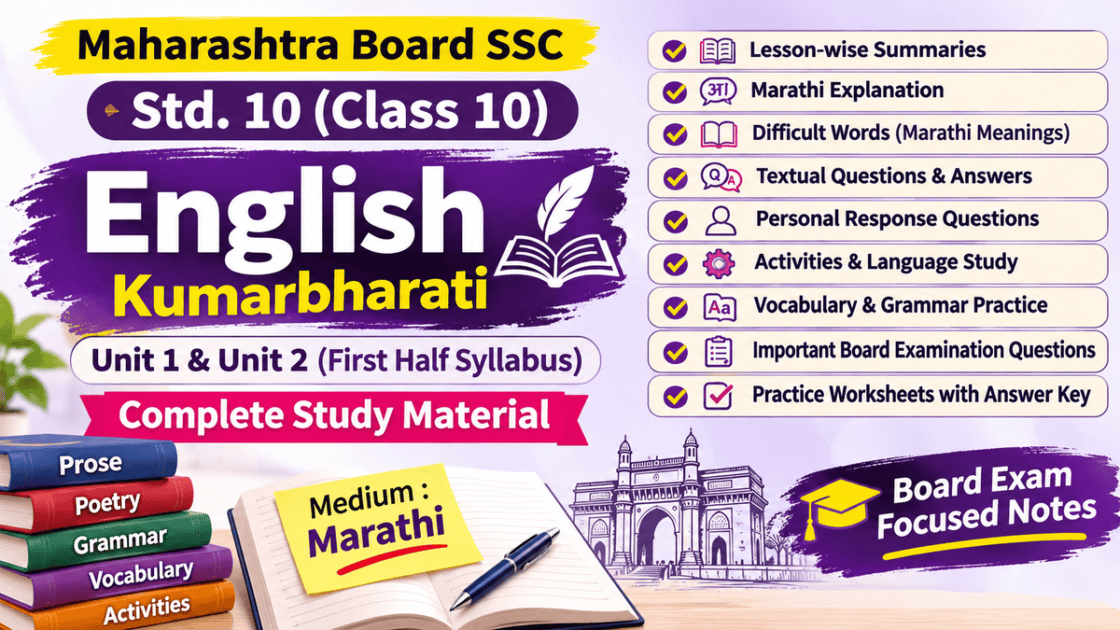
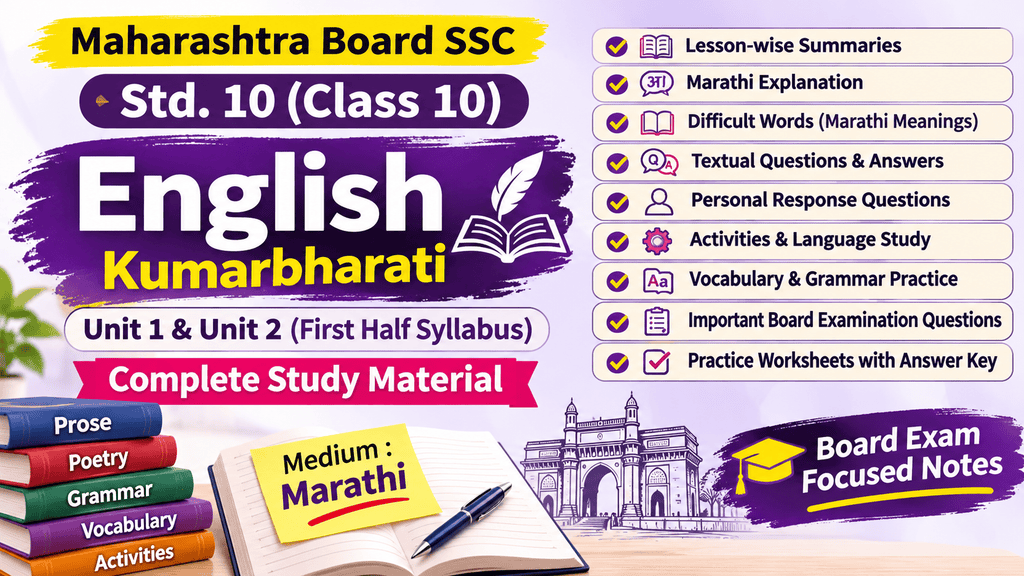
STD. 10 ENGLISH KUMARBHARATI
UNIT 1 & UNIT 2 – STUDY MATERIAL
Personal Response | Activities | Language Study | Vocabulary | Board Questions | Practice Worksheets
मराठी माध्यमाच्या विद्यार्थ्यांसाठी सोप्या इंग्रजीत अभ्यास साहित्य
UNIT ONE – LESSONS AND POEMS
1.1 Where the Mind is Without Fear – Rabindranath Tagore (Poem)
Central idea: The poet dreams of a country where people are fearless, truthful, knowledgeable and united.
मराठी अर्थ: कवीला असा देश हवा आहे जिथे लोक निर्भय, प्रामाणिक, ज्ञानी आणि एकत्रित असतील.
7. Personal Response
Ans. I would like to live in a country where there is equality, peace, education and justice.
Ans. Education removes ignorance and helps people think wisely.
Ans. We can make India better by being honest, hardworking and responsible citizens.
8. Activities and Language Study
- Write two qualities of an ideal country: Freedom and equality.
- Find opposites: Fear × Courage; Narrow × Broad; Truth × Falsehood.
- Identify the figure of speech in “Where the mind is without fear”: Repetition of the word ‘where’ in the poem.
- Write the central idea in two sentences.
9. Vocabulary and Grammar
| Word | Marathi meaning |
|---|---|
| Fear | भीती |
| Heaven | स्वर्ग |
| Knowledge | ज्ञान |
| Reason | विवेक / कारण |
| Truth | सत्य |
Grammar: Identify the noun: “Knowledge is power.” – Knowledge, power.
Opposites: Narrow – Broad; Dead – Alive.
10. Important Board Questions
Ans. He wishes for a country where people are fearless, truthful, educated and united.
Ans. It means logical and sensible thinking.
Ans. The poem expresses the dream of an ideal nation based on freedom, knowledge, truth and unity.
11. Practice Worksheet
1. Who wrote the poem?
2. The poet dreams of a country without ____.
3. Reason means:
4. The poem is a prayer for:
1.2 The Thief’s Story – Ruskin Bond
Central idea: Anil’s kindness and trust transform Hari Singh, a young thief, and inspire him to choose an honest life.
मराठी अर्थ: अनिलच्या प्रेमळ वागणुकीमुळे आणि विश्वासामुळे हरिसिंगच्या मनात परिवर्तन होते.
7. Personal Response
Ans. Yes. Kindness can change a person’s heart and encourage good behaviour.
Ans. Yes, if my friend sincerely regrets the mistake and promises not to repeat it.
Ans. Education helps us become independent and live with dignity.
8. Activities and Language Study
- Character traits of Anil: Kind, generous, trusting and helpful.
- Character traits of Hari Singh: Clever, dishonest initially, young and capable of change.
- Arrange the events: Hari meets Anil → Gets work → Steals money → Returns money.
- Write a short dialogue between Anil and Hari after Hari returns.
9. Vocabulary and Grammar
| Word | Marathi meaning |
|---|---|
| Trust | विश्वास |
| Deserted | निर्जन |
| Suspicious | संशयास्पद |
| Grateful | कृतज्ञ |
| Regret | पश्चात्ताप |
Grammar: Change into passive voice: Anil taught Hari. – Hari was taught by Anil.
Word formation: Honest – Honesty; Kind – Kindness.
10. Important Board Questions
Ans. He wanted to earn money and saw an opportunity to gain Anil’s trust.
Ans. Anil’s kindness and his desire to learn and become educated changed Hari’s mind.
Ans. Love, trust and kindness can bring positive changes in a person’s life.
11. Practice Worksheet
1. Who is the writer of the story?
2. What was Hari Singh?
3. Who offered Hari a job?
4. What changed Hari’s life?
Answer key: 1-a, 2-b, 3-a, 4-b.
1.3 On Wings of Courage
Central idea: The lesson presents the inspiring life and achievements of Air Marshal Arjan Singh, highlighting his courage, leadership and dedication to the nation.
मराठी अर्थ: एअर मार्शल अर्जन सिंह यांचे धैर्य, नेतृत्व आणि देशसेवेची प्रेरणादायी कहाणी.
7. Personal Response
Ans. Courage, discipline, honesty, confidence and decision-making make a good leader.
Ans. Yes. I would like to serve my country and protect its people.
Ans. We can show patriotism by respecting our country, following rules and serving society.
8. Activities and Language Study
- Write five qualities of Arjan Singh: Courage, discipline, leadership, dedication and confidence.
- Prepare a timeline of his important achievements.
- Expand the abbreviation IAF: Indian Air Force.
- Write a short paragraph on the importance of the armed forces.
9. Vocabulary and Grammar
| Word | Marathi meaning |
|---|---|
| Marshal | सर्वोच्च हवाई दलाचा मानाचा हुद्दा |
| Bravery | शौर्य |
| Leadership | नेतृत्व |
| Distinguished | विशेष / प्रतिष्ठित |
| Achievement | यश / कामगिरी |
Grammar: Change into adjective: Courage – Courageous; Fame – Famous; Strength – Strong.
Make a sentence: Arjan Singh was a courageous pilot.
10. Important Board Questions
Ans. He was a distinguished officer of the Indian Air Force and the first Marshal of the Indian Air Force.
Ans. He led the Indian Air Force with courage and skill during the Indo-Pak war of 1965.
Ans. He is remembered for his exceptional flying skills, leadership and dedicated service to the nation.
11. Practice Worksheet
1. Arjan Singh belonged to the:
2. He was known for his:
3. He led the IAF during the war of:
4. The opposite of courage is:
Answer key: 1-a, 2-a, 3-b, 4-a.
1.4 All the World’s a Stage – William Shakespeare (Poem)
Central idea: Shakespeare compares the world to a stage and human beings to actors who play seven different roles during their lives.
मराठी अर्थ: मानवी जीवन हे रंगमंचासारखे असून प्रत्येक व्यक्ती जीवनात वेगवेगळ्या भूमिका पार पाडते.
7. Personal Response
Ans. I enjoy my student life because I can learn new things and develop my personality.
Ans. They have rich experience and valuable knowledge of life.
Ans. I play the role of a responsible and caring family member.
8. Activities and Language Study
- Name the seven stages: Infant, schoolboy, lover, soldier, justice, old age and second childishness.
- Identify the figure of speech in “All the world’s a stage”: Metaphor.
- Explain the comparison between the world and a stage.
- Write two sentences about the responsibilities of a student.
9. Vocabulary and Grammar
| Word | Marathi meaning |
|---|---|
| Stage | रंगमंच / टप्पा |
| Infant | अर्भक |
| Justice | न्यायाधीश |
| Soldier | सैनिक |
| Existence | अस्तित्व |
Grammar: Identify the adjective: “The old man walks slowly.” – Old.
Figure of speech: Metaphor – direct comparison without using ‘like’ or ‘as’.
10. Important Board Questions
Ans. The world is compared to a stage.
Ans. Seven stages of life are described.
Ans. Human life passes through different stages, and every person performs different roles.
11. Practice Worksheet
1. Who wrote the poem?
2. The world is compared to a:
3. How many stages are described?
4. The figure of speech in the title is:
Answer key: 1-a, 2-b, 3-a, 4-b.
1.5 Joan of Arc
Central idea: Joan of Arc was a brave French girl who believed in her mission and inspired the French army to fight for their country.
मराठी अर्थ: जोन ऑफ आर्क ही धाडसी मुलगी होती. तिच्या देशभक्तीने आणि आत्मविश्वासाने फ्रेंच सैनिकांना प्रेरणा दिली.
7. Personal Response
Ans. I admire her courage, determination, patriotism and confidence.
Ans. Yes. Young people can bring change through courage, knowledge and positive action.
Ans. I would remain calm, think positively and face the situation courageously.
8. Activities and Language Study
- Write five qualities of Joan: Brave, determined, patriotic, confident and inspiring.
- Prepare a short speech on women empowerment.
- Write a dialogue between Joan and a soldier.
- Arrange the important events of the lesson in sequence.
9. Vocabulary and Grammar
| Word | Marathi meaning |
|---|---|
| Determination | दृढनिश्चय |
| Mission | ध्येय |
| Victory | विजय |
| Faith | श्रद्धा / विश्वास |
| Courage | धैर्य |
Grammar: Noun to adjective: Courage – Courageous; Patriot – Patriotic; Confidence – Confident.
10. Important Board Questions
Ans. Joan of Arc was a young French girl who became a national heroine because of her courage and leadership.
Ans. Her strong faith, determination and love for France inspired her to fight.
Ans. We learn to be courageous, determined and faithful to our ideals.
11. Practice Worksheet
1. Joan of Arc belonged to:
2. Joan is remembered for her:
3. The opposite of victory is:
4. A person who loves one’s country is:
Answer key: 1-a, 2-b, 3-a, 4-a.
1.6 The Alchemy of Nature
Central idea: Nature works like an alchemist. It transforms ordinary things into beautiful and valuable creations through its wonderful processes.
मराठी अर्थ: निसर्गामध्ये सामान्य गोष्टींचे सुंदर आणि अद्भुत रूपात परिवर्तन करण्याची शक्ती आहे.
7. Personal Response
Ans. Nature provides us with air, water, food and shelter. We must protect it for future generations.
Ans. I enjoy watching the sunrise because it fills me with hope and energy.
Ans. Students can plant trees, save water and avoid plastic.
8. Activities and Language Study
- List five gifts of nature: Air, water, trees, sunlight and soil.
- Write a paragraph on tree plantation.
- Explain the title ‘The Alchemy of Nature’.
- Write two slogans on environmental protection.
9. Vocabulary and Grammar
| Word | Marathi meaning |
|---|---|
| Alchemy | रूपांतर करण्याची अद्भुत कला |
| Transform | रूपांतर करणे |
| Marvel | आश्चर्यकारक गोष्ट |
| Nature | निसर्ग |
| Magnificent | भव्य / सुंदर |
Grammar: Change into plural: Leaf – Leaves; Branch – Branches; Flower – Flowers.
10. Important Board Questions
Ans. Nature is called an alchemist because it transforms ordinary things into wonderful and beautiful forms.
Ans. We can learn patience, beauty, harmony, change and the importance of balance.
Ans. Nature inspires us through its beauty, variety and continuous process of renewal.
11. Practice Worksheet
1. Alchemy means:
2. Nature provides us with:
3. The plural of leaf is:
4. We should protect:
Answer key: 1-a, 2-b, 3-b, 4-a.
UNIT TWO – LESSONS AND POEMS
2.1 Animals – Walt Whitman (Poem)
Central idea: The poet admires animals because they are calm, contented, honest and free from human greed and complaints.
मराठी अर्थ: प्राण्यांचे साधेपण, समाधान आणि निरागस स्वभाव कवीला आवडतो. माणसांनीही हे गुण आत्मसात करावेत.
7. Personal Response
Ans. I like animals because they are innocent, loving and loyal.
Ans. We can learn contentment, honesty and simplicity from animals.
Ans. We should treat animals kindly and protect them from cruelty.
8. Activities and Language Study
- Write five qualities of animals: Innocence, simplicity, calmness, loyalty and contentment.
- Identify the poet: Walt Whitman.
- Write a short paragraph on kindness towards animals.
- Identify the repeated expression in the poem and explain its effect.
9. Vocabulary and Grammar
| Word | Marathi meaning |
|---|---|
| Contented | समाधानी |
| Complain | तक्रार करणे |
| Innocent | निरागस |
| Calm | शांत |
| Humble | नम्र |
Grammar: Adjective forms: Beauty – Beautiful; Peace – Peaceful; Care – Careful.
Poetic device: Repetition is used to emphasise the poet’s thoughts about animals.
10. Important Board Questions
Ans. He admires animals because they are peaceful, contented and free from human greed.
Ans. Animals do not show greed, complaints, dissatisfaction and false pretensions.
Ans. Human beings should learn simplicity, honesty and contentment from animals.
11. Practice Worksheet
1. Who wrote ‘Animals’?
2. The poet admires:
3. Contented means:
4. The poem teaches us:
Answer key: 1-a, 2-a, 3-b, 4-b.
2.2 Three Questions – Leo Tolstoy
Central idea: The story teaches that the most important time is the present, the most important person is the one with us, and the most important work is to do good to that person.
मराठी अर्थ: वर्तमान काळ, आपल्या समोर असलेली व्यक्ती आणि तिचे भले करणे हे जीवनातील सर्वात महत्त्वाचे आहे.
7. Personal Response
Ans. Helping others makes society kind, peaceful and happy.
Ans. The best time to do good work is the present moment.
Ans. We can become better by being kind, honest, helpful and forgiving.
8. Activities and Language Study
- Write the three important questions asked by the king.
- Write the hermit’s answers in your own words.
- Prepare a dialogue between the king and the hermit.
- Write a moral of the story in one sentence.
9. Vocabulary and Grammar
| Word | Marathi meaning |
|---|---|
| Hermit | संन्यासी |
| Advice | सल्ला |
| Urgent | तातडीचे |
| Forgive | माफ करणे |
| Wound | जखम |
Grammar: Change into indirect speech: The king said, “I am happy.” – The king said that he was happy.
10. Important Board Questions
Ans. The king wanted to know the right time to begin everything, the right people to listen to and the most important thing to do.
Ans. The most important time is now, the most important person is the one with us, and the most important work is to do good to that person.
Ans. The king cared for the wounded man, washed and dressed his wounds and helped him recover.
11. Practice Worksheet
1. Who wrote the story?
2. Where did the king meet the hermit?
3. The most important time is:
4. The wounded man was:
Answer key: 1-a, 2-b, 3-b, 4-a.
2.3 Connecting the Dots – Steve Jobs
Central idea: Steve Jobs explains how connecting past experiences, following one’s passion and facing difficulties can lead to success.
मराठी अर्थ: आपल्या आयुष्यातील अनुभव, आवड आणि अपयश यांतून शिकून पुढे जाणे महत्त्वाचे आहे.
7. Personal Response
Ans. Following our passion gives us satisfaction and motivates us to work hard.
Ans. Failure teaches us valuable lessons and helps us improve.
Ans. I believe in hard work because it helps us achieve our goals.
8. Activities and Language Study
- Write three important life lessons: Follow your passion, learn from failure and never lose hope.
- Prepare a short speech on ‘Never Give Up’.
- Write a brief note on Steve Jobs.
- Complete the sentence: Your time is limited, so ______. (Answer: use it wisely.)
9. Vocabulary and Grammar
| Word | Marathi meaning |
|---|---|
| Passion | आवड / उत्कट इच्छा |
| Connect | जोडणे |
| Failure | अपयश |
| Curiosity | जिज्ञासा |
| Achievement | यश |
Grammar: Change into past tense: He starts a company. – He started a company.
Word formation: Successful – Success; Curious – Curiosity.
10. Important Board Questions
Ans. It means understanding how our past experiences are connected and useful in shaping our future.
Ans. Our experiences teach us lessons that may become useful in the future.
Ans. He advises students to follow their passion, remain curious and never give up.
11. Practice Worksheet
1. Who delivered the famous Stanford speech?
2. We should learn from:
3. Passion means:
4. We should follow our:
Answer key: 1-a, 2-a, 3-a, 4-a.
2.4 The Pulley – George Herbert (Poem)
Central idea: God gives human beings many blessings but keeps rest from them so that they may turn towards Him when they face difficulties.
मराठी अर्थ: देवाने माणसाला अनेक गुण आणि सुखे दिली; मात्र विश्रांती न देता त्याला देवाकडे वळण्याची संधी ठेवली.
7. Personal Response
Ans. We should be thankful for life, health, nature and all the blessings we receive.
Ans. Peace of mind is more important because it gives us real happiness.
Ans. I remain hopeful, work hard and seek guidance when needed.
8. Activities and Language Study
- List blessings given to human beings: Strength, beauty, wisdom, honour and pleasure.
- Explain the title ‘The Pulley’.
- Identify the poet: George Herbert.
- Write the central idea of the poem in three sentences.
9. Vocabulary and Grammar
| Word | Marathi meaning |
|---|---|
| Bestow | प्रदान करणे |
| Treasure | खजिना |
| Rest | विश्रांती |
| Repining | खंत व्यक्त करणे |
| Weariness | थकवा |
Grammar: Identify the abstract nouns: Wisdom, beauty, strength, honour.
Poetic device: The pulley is used as a symbolic image in the poem.
10. Important Board Questions
Ans. God gave them strength, beauty, wisdom, honour, pleasure and other blessings.
Ans. God kept rest away so that human beings might turn towards Him when they became weary.
Ans. The poem teaches gratitude and reminds us of the importance of spiritual connection.
11. Practice Worksheet
1. Who wrote ‘The Pulley’?
2. God gave man many:
3. Rest is associated with:
4. The poem expresses:
Answer key: 1-a, 2-a, 3-a, 4-a.
2.5 Let’s March
Central idea: The lesson highlights the struggle against child labour and the importance of protecting children’s rights, dignity, education and freedom.
मराठी अर्थ: बालमजुरी थांबवून प्रत्येक मुलाला शिक्षण, स्वातंत्र्य आणि सन्मान मिळावा हा या पाठाचा संदेश आहे.
7. Personal Response
Ans. Every child should go to school to receive education and build a better future.
Ans. We can report child labour, spread awareness and support children’s education.
Ans. Children have the right to education, protection, health, freedom and dignity.
8. Activities and Language Study
- List five rights of children: Education, protection, equality, health and freedom.
- Write slogans against child labour.
- Prepare a short speech on ‘Every Child in School’.
- Write a short dialogue between a social worker and a child labourer.
9. Vocabulary and Grammar
| Word | Marathi meaning |
|---|---|
| Child Labour | बालमजुरी |
| Exploitation | शोषण |
| Dignity | सन्मान |
| Freedom | स्वातंत्र्य |
| Campaign | मोहीम |
Grammar: Change into passive voice: People must protect children. – Children must be protected by people.
Word formation: Educate – Education; Protect – Protection.
10. Important Board Questions
Ans. The main aim is to create awareness against child labour and protect children’s rights.
Ans. It deprives children of education, health, freedom and a happy childhood.
Ans. Society can help by providing education, preventing exploitation and ensuring equal opportunities.
11. Practice Worksheet
1. Child labour means:
2. Every child has the right to:
3. Dignity means:
4. Child labour should be:
Answer key: 1-a, 2-a, 3-a, 4-b.
2.6 Science and Spirituality
Central idea: Science and spirituality can work together. Science develops knowledge and technology, while spirituality guides human beings towards values, peace and responsible living.
मराठी अर्थ: विज्ञान ज्ञान आणि तंत्रज्ञान देते, तर अध्यात्म जीवनात नैतिक मूल्ये, शांतता आणि जबाबदारीची जाणीव निर्माण करते.
7. Personal Response
Ans. Science makes our life easier through inventions, discoveries and technology.
Ans. Moral values help us use knowledge responsibly and live peacefully.
Ans. Yes. Science gives us knowledge, while spirituality helps us use it wisely.
8. Activities and Language Study
- Write two benefits of science: Better healthcare and improved communication.
- Write two benefits of spirituality: Inner peace and moral values.
- Prepare a chart comparing science and spirituality.
- Write a short paragraph on the responsible use of technology.
9. Vocabulary and Grammar
| Word | Marathi meaning |
|---|---|
| Spirituality | अध्यात्म |
| Scientific | वैज्ञानिक |
| Consciousness | जाणीव |
| Ethics | नीतिमूल्ये |
| Harmony | सुसंवाद / समतोल |
Grammar: Join using ‘and’: Science gives knowledge. Spirituality gives values. – Science gives knowledge and spirituality gives values.
Word formation: Science – Scientific; Spirit – Spiritual; Responsible – Responsibility.
10. Important Board Questions
Ans. Science and spirituality complement each other. Both can contribute to the progress and well-being of humanity.
Ans. Science improves human life through inventions, medical progress, communication and technology.
Ans. Values help us use scientific knowledge ethically and for the benefit of society.
11. Practice Worksheet
1. Science mainly develops:
2. Spirituality promotes:
3. Ethics means:
4. Science and spirituality should:
Answer key: 1-a, 2-b, 3-a, 4-b.
GENERAL REVISION – UNIT 1 & UNIT 2
Important Grammar Revision
| Topic | Example |
|---|---|
| Articles | He is an honest man. |
| Preposition | She is interested in music. |
| Tense | He has completed his work. |
| Passive Voice | The letter was written by Ravi. |
| Reported Speech | He said that he was busy. |
| Modal Auxiliary | We should respect elders. |
| Question Tag | She is kind, isn’t she? |
| Word Formation | Kind – Kindness. |
Quick Vocabulary Revision
| Word | Synonym | Antonym |
|---|---|---|
| Courage | Bravery | Fear |
| Honest | Truthful | Dishonest |
| Victory | Success | Defeat |
| Kind | Gentle | Cruel |
| Calm | Peaceful | Agitated |
| Happy | Joyful | Sad |
| Begin | Start | End |
| Beautiful | Attractive | Ugly |
ENGLISH FOR ME
Learn • Practise • Improve • Succeed
Std. 10 Maharashtra State Board – English Kumarbharati